
Why Marketing Plans Fail in Delivery — and How to Fix It
A marketing plan can look perfectly sensible on paper.
The objectives are clear. The target customers have been identified. The strategy makes sense. The activities have been agreed. There may even be a detailed calendar showing exactly what should happen and when.
Then reality takes over.
Campaigns are delayed. Content doesn't get produced. Other business priorities intervene. Nobody is quite sure who owns particular activities. The marketing team becomes overloaded. External specialists work on individual tasks without seeing the wider picture.
Gradually, the plan becomes something the business intended to do rather than something it is actually delivering.
The problem isn't necessarily the marketing plan.
There is often a gap between knowing what you want to do and having the capability and capacity to do it consistently.
Understanding that gap can help you fix delivery without unnecessarily starting the planning process again.
1. A Good Plan Doesn't Guarantee Good Delivery
Planning and implementation require different things.
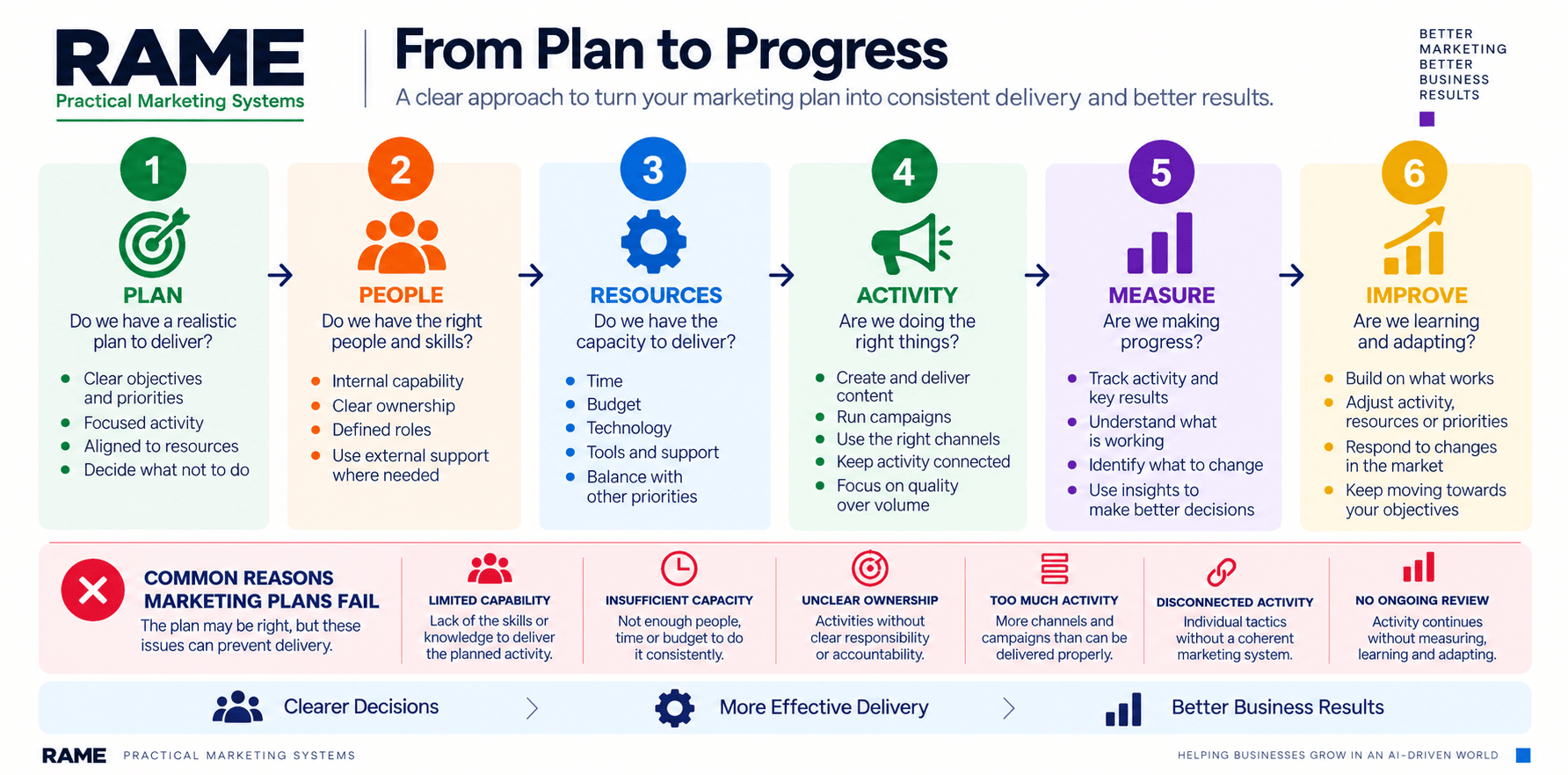
A marketing plan establishes priorities and determines what the business intends to do. Delivery requires people, skills, resources, processes, coordination and ongoing decisions.
That distinction matters.
When implementation begins to struggle, businesses sometimes assume the strategy must be wrong. They change campaigns, introduce new channels or rewrite the plan.
But before changing direction, ask a more basic question:
Is the plan wrong — or are we struggling to deliver it?
Those are very different problems and require different solutions.
2. Understand the Difference Between Capability and Capacity
One of the most useful ways to diagnose a delivery problem is to separate capability from capacity.
Marketing capability
Capability is having the knowledge, skills and systems required to do the right things.
That might include:
understanding your customers and markets
knowing how to build and manage campaigns
producing effective content
selecting and managing appropriate channels
interpreting marketing performance
making informed marketing decisions
having repeatable processes for getting work done
Marketing capacity
Capacity is having sufficient resources to put that capability into practice.
That includes:
people
time
budget
technology
external support
A business can have plenty of capacity but limited capability. It may be extremely busy without necessarily doing the right things.
Equally, it can understand exactly what needs to happen but simply lack the resources to deliver it.
Before adding more marketing activity, identify which problem you actually have.
3. Make Ownership Clear
Plans frequently contain activities without making responsibility sufficiently clear.
“Create new case studies.”
“Improve email marketing.”
“Develop LinkedIn activity.”
“Launch the campaign.”
But who actually owns each one?
Good delivery requires more than assigning somebody a task. The person responsible needs to understand:
What needs to happen?
Why does it matter?
When does it need to happen?
What resources are available?
How will success be measured?
Where several people or departments are involved, responsibilities become even more important.
Marketing may create demand, but sales may need to follow up enquiries. Operations may need to support a campaign promise. Customer service may provide the insight needed for new content.
Marketing delivery therefore cannot always be treated as the responsibility of the marketing department alone.
4. Be Realistic About What You Can Deliver
One of the easiest ways to undermine a marketing plan is to put too much into it.
Businesses naturally want to make progress quickly, so plans accumulate activity.
More content.
More campaigns.
More social media.
More email.
More events.
More reporting.
Individually, each activity may seem reasonable. Collectively, they can exceed the organisation's capacity to deliver them properly.
The result is often lots of partially completed marketing rather than a smaller number of activities executed well.
A practical marketing plan should therefore reflect the resources actually available.
Prioritisation is part of implementation.
Deciding what you will not do can be every bit as important as deciding what you will.
5. Use External Marketing Support for the Right Reasons
Few businesses need — or can justify — maintaining every specialist marketing capability internally.
External marketing specialists can provide valuable expertise in areas such as websites, SEO, advertising, content, design and technology.
But external expertise works best when the business retains control of the bigger marketing decision.
Before commissioning specialist support, you should understand:
what business or marketing objective it supports
why this activity is a priority
how it connects with other marketing activity
what the specialist is responsible for
how performance will be evaluated
Otherwise, it is easy to accumulate individual marketing solutions without building a connected marketing system.
Use specialists for their expertise. Don't outsource your understanding of your own marketing.
6. Don't Confuse Activity With Progress
A busy marketing function can create the impression that the plan is being delivered successfully.
But activity alone tells you very little.
Publishing more posts, sending more emails, running more campaigns or increasing website traffic does not automatically mean marketing is moving the business towards its objectives.
Return regularly to the purpose behind the activity.
Ask:
What were we trying to achieve?
What has actually happened?
What are we learning?
What should we continue, change or stop?
That moves measurement away from simply reporting what marketing has done towards understanding what marketing is achieving.
7. Expect the Plan to Meet Reality
No marketing plan operates in a static environment.
Customers change.
Competitors respond.
Budgets move.
Internal priorities change.
Campaigns sometimes underperform.
Unexpected opportunities appear.
A useful marketing plan therefore shouldn't become a rigid set of instructions that must be followed regardless of what happens.
But neither should every change send the business back into reactive marketing.
The answer is controlled adaptation.
Plan → Measure → Learn → Adapt
Keep the objectives clear, monitor what is happening and adjust activities, priorities or resources when the evidence tells you that you should.
Changing the plan isn't the same as abandoning it.
8. Build Continuous Improvement Into Delivery
Marketing implementation shouldn't end with completing a list of activities.
Each cycle of delivery should make the next one better.
Capture what you learn.
Which activities worked?
Which took more resource than expected?
Where did work become delayed?
Which channels produced useful results?
What did customers respond to?
Where did teams or external specialists struggle to coordinate?
Those lessons become part of your marketing capability.
Over time, processes improve, decisions become better informed and the business becomes more effective at turning plans into results.
That is how marketing moves from a series of individual activities towards a repeatable marketing system.
A Simple Marketing Delivery Check
If your marketing plan isn't progressing as expected, ask these five questions:
Are our objectives and priorities still clear?
Do we have the capability to deliver what we've planned?
Do we have sufficient people, time, budget and resources?
Is ownership of each important activity clear?
Are we measuring, learning and adapting as we go?
If you cannot answer all five confidently, the solution may not be another campaign or another marketing plan.
It may be improving the system that turns your plan into action.
The Key Takeaway
Good marketing delivery isn't simply about getting more things done.
It is about turning clear priorities into coordinated action, making sensible use of the resources available and continually learning from what happens.
A marketing plan gives you direction. A marketing system helps you deliver it.
Continue Your RAME Journey
Related article: How to Know Which Marketing Activities Are Actually Worth Doing
Related framework: Marketing Objectives Builder
Related book: Delivering Your Marketing Plan
Related Learning Kit: Module 5 — Delivering Your Marketing Plan