
How to Know Which Marketing Activities Are Actually Worth Doing
With more marketing channels, tools and technologies available than ever, the challenge isn't finding things you could do. It's deciding what you should do.
Marketing has never offered businesses more choice.
SEO. Paid search. Social media. Email. Content. Video. Events. Direct marketing. Partnerships. Marketing automation. CRM. Influencer marketing. Podcasts. Webinars. AI.
And that's before the next platform, tool or marketing acronym appears.
For smaller and medium-sized businesses in particular, this creates a problem.
You can't do everything.
You probably shouldn't try.
The important question isn't:
“What marketing activities should we be doing?”
It's:
“Which marketing activities are most likely to help us achieve what the business actually needs?”
That sounds like a subtle distinction.
It isn't.
It's the difference between building a marketing plan around your objectives and assembling a collection of activities because they appear to be things modern businesses are supposed to do.
More Marketing Activity Doesn't Necessarily Mean Better Marketing
It's easy to see marketing activity.
Posts are published.
Emails are sent.
Advertising campaigns run.
Website traffic increases.
Content is produced.
Events are attended.
Reports show clicks, impressions, followers and engagement.
All of that can create the reassuring sense that marketing is happening.
But activity isn't the same as progress.
A business can be extremely busy marketing without getting significantly closer to its commercial objectives.
That's why the starting point shouldn't be the activity.
It should be the business result you're trying to achieve.
Perhaps you need to:
Generate more qualified sales opportunities.
Enter a new market.
Increase sales of a particular product or service.
Improve customer retention.
Increase repeat purchasing.
Improve conversion.
Build awareness within a specific audience.
Increase customer value.
Reduce the cost of acquiring customers.
Those objectives could require very different marketing responses.
Until you know what needs to change, deciding whether you need more content, advertising, SEO or social media is premature.
Don't Start With the Channel
One of the most common marketing questions is:
“Should we be doing more on LinkedIn?”
Or Google Ads.
Or SEO.
Or email.
Or video.
Or, increasingly, AI.
But a channel isn't a strategy.
Before deciding whether a particular activity belongs in your marketing plan, work backwards from the result you need.
A useful sequence is:
Business Objective → Audience → Required Change → Barrier → Marketing Activity → Measure
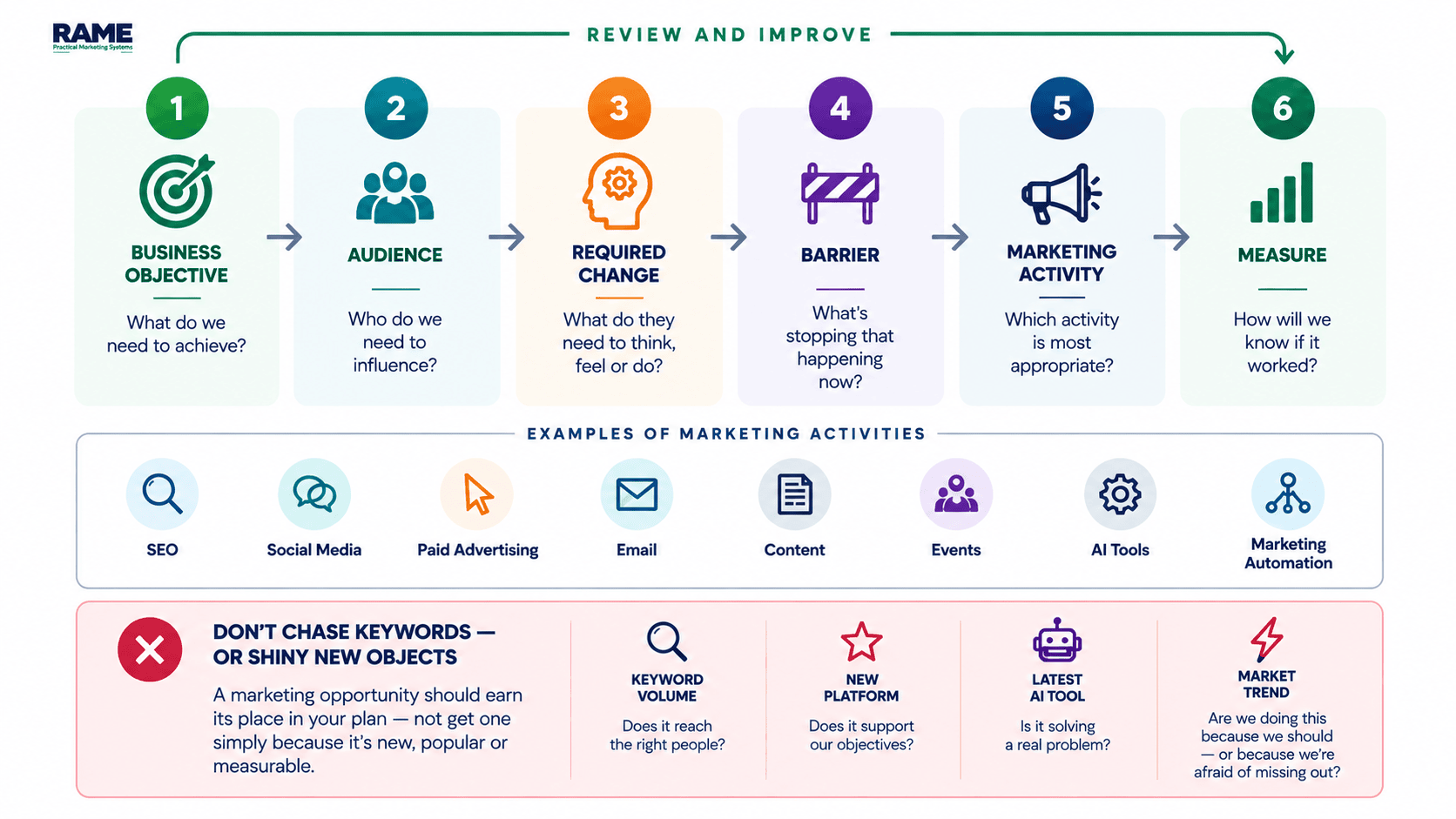
Let's look at each stage.
1. What Business Result Are You Trying to Achieve?
Be specific.
“Grow the business” is an ambition.
“Generate 20 additional qualified opportunities from manufacturing businesses over the next six months” gives marketing something much more useful to work with.
The clearer the objective, the easier it becomes to evaluate potential activity.
2. Who Do You Need to Influence?
Which customers, prospects or other audiences matter to that objective?
Trying to reach everybody usually leads to broad, unfocused marketing.
Instead, understand who needs to think, feel or behave differently for the business objective to be achieved.
3. What Needs to Change?
Do people need to discover you?
Understand you?
Trust you?
Consider you?
Choose you?
Return to you?
Buy something else from you?
Recommend you?
Marketing activity should be designed to influence something.
Knowing what that is makes choosing the activity considerably easier.
4. What's Preventing That From Happening Now?
This is where the real marketing problem often emerges.
Perhaps potential customers don't know the business exists.
Perhaps they know you but don't understand why they should choose you.
Perhaps the website attracts the right people but doesn't convert them.
Perhaps prospects are interested but aren't ready to buy.
Perhaps good leads aren't being followed up effectively.
Perhaps customers buy once but aren't given a reason to return.
Different barriers require different solutions.
More website traffic won't necessarily solve a conversion problem.
More leads won't solve poor sales follow-up.
More social content won't necessarily solve an unclear proposition.
And more advertising won't fix a poor customer experience.
5. Which Activity Is Most Appropriate?
Only now should you start choosing marketing activities.
If awareness is the problem, advertising, PR, search, events or targeted content may deserve consideration.
If prospects need greater confidence, case studies, reviews, demonstrations, detailed content or customer evidence may be more useful.
If prospects aren't ready to buy, email and nurturing content may help maintain the relationship.
If conversion is weak, improving the website, proposition, calls to action or follow-up process may matter more than generating additional traffic.
The point isn't that one channel is inherently better than another.
It's that the activity should be chosen because it addresses a defined problem.
Don't Let Keywords Set Your Marketing Agenda
SEO provides a good example of how the sequence can become reversed.
Keyword research is extremely useful.
It can reveal how people search, the language they use, questions they ask and areas where useful content could help your business become discoverable.
But search volume alone doesn't make a subject commercially important.
A keyword may attract thousands of searches while having very little connection with the customers your business actually wants.
Equally, a lower-volume search used by precisely the right prospective customer could be considerably more valuable.
The danger comes when the process becomes:
Find keyword → See search volume → Create content → Generate traffic
without asking:
Who is searching?
Why are they searching?
Are these people relevant to us?
Does the subject connect with what we genuinely know about?
What would we like the visitor to do next?
SEO should support your marketing strategy.
It shouldn't become your marketing strategy.
Don't Chase Every Shiny New Object Either
Keywords aren't the only distraction.
Marketing has always produced shiny new objects.
A new social platform appears.
A new advertising format gains attention.
A new piece of marketing software promises dramatic improvements.
A new content format becomes fashionable.
A new AI application launches.
A new approach to search emerges.
Suddenly businesses start asking:
“Should we be doing this?”
Sometimes the answer will be yes.
New technologies and channels can create genuine opportunities.
Ignoring change isn't a strategy either.
But the existence of an opportunity doesn't automatically make it the right opportunity for your business.
Before chasing a keyword, platform, technology or trend, ask:
Does this help us reach the customers we want to reach, influence something that matters to them and contribute to a defined business objective?
If it does, investigate it.
If it doesn't, its popularity is largely irrelevant.
A marketing opportunity should earn its place in your plan — not get one simply because it's new, popular or measurable.
AI Makes This Discipline Even More Important
AI is reducing the effort required to perform many marketing activities.
We can research faster.
Produce content faster.
Analyse information faster.
Create variations faster.
Automate processes.
Generate reports.
Repurpose material.
That creates enormous opportunities.
It also creates a risk.
When the cost and effort of doing something falls dramatically, it's tempting simply to do more of it.
More articles.
More posts.
More emails.
More analysis.
More campaigns.
More content.
But the ability to produce more marketing activity doesn't automatically create a reason to produce it.
Before asking:
“How can AI help us do more?”
ask:
“Is this something we should be doing in the first place?”
AI can make good marketing activity more efficient.
It can also help businesses produce unnecessary marketing activity with extraordinary efficiency.
Strategy still has to decide which is which.
Review What You're Already Doing
Choosing marketing activities isn't only about deciding what to add.
Most established businesses already have marketing activity underway.
So periodically review it.
A simple Stop, Start, Continue exercise can be surprisingly useful.
STOP
Which activities no longer make a sufficient contribution?
They may once have worked extremely well.
That doesn't mean they deserve a permanent place in the plan.
Look for activities that consume time, budget or attention without producing enough value.
START
What does the evidence suggest you aren't currently doing but should consider?
This could be a new channel or technology.
But it could equally be something less fashionable:
Talking to customers.
Improving follow-up.
Creating better sales material.
Developing customer case studies.
Improving conversion.
Building an email database.
Producing content that answers genuine customer questions.
CONTINUE
Which activities are still working?
This is important.
A marketing review shouldn't become an excuse to change things simply because they're familiar.
If something continues to contribute to your objectives, keep doing it.
And consider whether it could be improved further.
One More Question Before You Put Something Into “Start”
Whenever a new idea appears, ask:
“Are we starting this because the evidence suggests we should — or because we're afraid of missing out?”
That question becomes increasingly useful as the pace of marketing technology accelerates.
Being aware of a new development is sensible.
Experimenting can be valuable.
But neither requires abandoning strategic judgement.
Sometimes the correct marketing decision is to watch, learn and do nothing yet.
Decide How You Will Measure It Before You Start
Every significant marketing activity should have a purpose.
That means you should also know what success would look like.
If you're trying to generate qualified opportunities, measure qualified opportunities — not simply clicks.
If you're trying to improve conversion, measure conversion.
If you're trying to increase repeat purchasing, measure customer behaviour.
If you're trying to reach a particular market, understand whether you're actually reaching that market.
Marketing platforms naturally encourage us to focus on the metrics they can easily provide.
Those metrics can be useful.
But the easiest thing to measure isn't necessarily the most important thing to measure.
Start with the objective and work forward to the appropriate measure.
There Isn't a Universal Marketing Checklist
This is why articles promising the “10 marketing activities every small business should be doing” need to be treated carefully.
There are certainly activities that are valuable to many businesses.
But businesses have different:
Customers.
Markets.
Resources.
Objectives.
Sales cycles.
Capabilities.
Competitive positions.
Problems.
A marketing activity that is essential for one business could be largely irrelevant to another.
So there isn't a universal checklist that every SME needs to complete.
There is something more useful:
A disciplined way of deciding what deserves a place in your marketing system.
Start with the business objective.
Identify the people you need to influence.
Understand what needs to change.
Identify what's preventing that change.
Choose the activities most likely to address it.
Decide how you'll measure the result.
Learn from what happens.
Then improve.
Do the Things That Matter
Modern marketing provides extraordinary choice.
AI will increase that choice even further.
The challenge for businesses won't be finding enough marketing activities to fill their time.
It will increasingly be deciding which opportunities deserve their attention — and which don't.
So before adding another activity to your marketing plan, ask:
What are we trying to achieve?
Who are we trying to influence?
What needs to change?
What's preventing it?
Why is this activity the right response?
How will we know whether it worked?
If you can't answer those questions, don't automatically do more marketing.
Do some better thinking first.
Because effective marketing isn't about doing everything you could do.
It's about doing the things that matter.
Continue Your RAME Journey
Related Framework — Marketing Objectives Builder
Clarify what your marketing needs to achieve before deciding which activities belong in your plan.
Related Learning Kit — Module 5: Delivering Your Marketing Plan
Turn your marketing plan into structured activity, measure what happens and continuously improve performance.
Related Book — Delivering Your Marketing Plan
A practical guide to turning marketing strategy into coordinated action, measurement and continuous improvement.