
Why Isn't Your Marketing Generating Enough Enquiries?
More marketing activity doesn't necessarily mean more enquiries. Before increasing your budget or launching another campaign, you need to understand what's preventing potential customers from contacting your business.
Many businesses invest in websites, social media, search engine optimisation, advertising and content marketing but still struggle to generate a consistent flow of worthwhile enquiries.
The natural response is often to do more: publish more content, spend more on advertising or try another marketing channel.
But if the underlying problem hasn't been identified, increasing activity may simply increase costs.
The better starting point is to understand where your marketing is failing to turn potential demand into genuine customer interest.
There are six areas worth investigating.
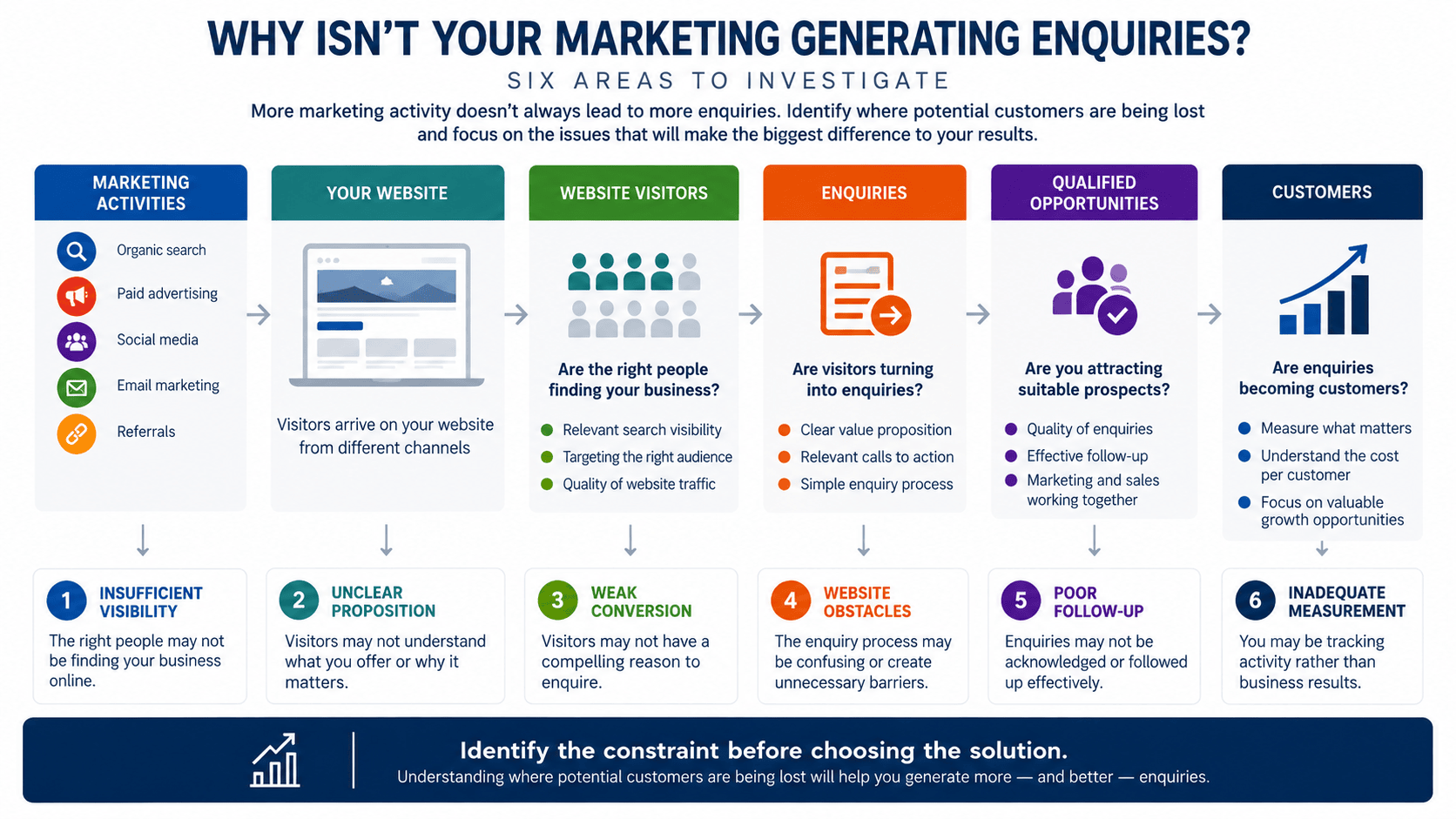
1. Are Enough of the Right People Finding Your Business?
Before you can generate enquiries, prospective customers need to discover your business.
However, visibility alone isn't enough. Attracting thousands of visitors who have little interest in your products or services is unlikely to produce worthwhile results.
Consider:
Are you visible when potential customers search for the problems you solve?
Are your marketing activities reaching the people most likely to buy?
Are you attracting relevant visitors or simply increasing traffic?
Are you relying too heavily on one marketing channel?
What to do: Find out who is visiting your website
Start with two free Google tools.
Google Analytics 4 (GA4)
Open Reports → Acquisition → Traffic acquisition to see where website visits originate, including organic search, paid advertising, social media and referrals.
Look at:
Which channels bring the most visitors?
Which channels generate important actions, such as completed enquiry forms, if these are configured as key events?
Are you attracting more visitors without generating more enquiries?
Google Search Console (formerly Google Webmaster Tools)
Open Performance → Search results to examine the search queries that bring people to your website.
Look at:
Which search terms generate clicks?
Are those searches relevant to your products or services?
Are people finding your website when searching for problems you solve?
If you haven't configured GA4 or Google Search Console, getting these tools working is an important first step.
Practical example
An engineering company might receive substantial traffic from searches for technical definitions but very few enquiries.
Meanwhile, searches for a particular testing service may attract fewer visitors but generate more qualified prospects.
The priority may be to improve visibility for commercially relevant searches rather than simply increasing total traffic.
Your next action: Identify your three most valuable traffic sources and check whether they generate relevant enquiries. If enquiry tracking isn't configured, make that an immediate priority.
2. Is Your Value Proposition Clear?
Even when potential customers find your business, they may not understand why they should choose you.
A website can describe products, services and company capabilities without clearly explaining the benefits customers receive.
Visitors should quickly understand:
What problem you help them solve.
Who your products or services are intended for.
What makes your approach relevant to their needs.
What they should do next.
What to do: Test whether your message is clear
Open your homepage and your three most important product or service pages.
Ask someone unfamiliar with your business to spend ten seconds looking at each page, then explain:
What does this business offer?
Who is it intended for?
What problem does it solve?
Why should someone choose it?
Practical example
Weak message:
“Innovative engineering solutions for modern businesses.”
Stronger message:
“Test and measurement equipment that helps telecoms engineers identify network faults and reduce downtime.”
The second message makes the audience, offering and benefit much clearer.
The aim isn't to make every headline longer. It's to make your proposition easier to understand.
Your next action: Rewrite one important page headline to explain the customer benefit rather than simply describing your business.
3. Are You Giving People a Reason to Enquire?
Some businesses attract suitable visitors and explain their offering clearly but fail to provide a compelling next step.
A generic Contact Us button may not be enough, particularly when customers are still researching their options.
Different buyers may need different opportunities to engage.
These might include requesting a demonstration, obtaining a quotation, downloading a useful guide or asking a specific question.
What to do: Give visitors a relevant next step
Review the main calls to action on your homepage, product pages and service pages.
Ask whether each CTA matches what the visitor is likely to need at that stage.
Practical examples
A visitor researching a technical problem might appreciate a practical troubleshooting guide.
Someone comparing solutions might want a product comparison or demonstration.
A buyer ready to purchase might need a quotation or availability information.
Compare a vague button such as Learn More with a specific action such as Request a Product Demonstration.
The second makes the next step much clearer.
Also consider what happens after someone clicks. Does the visitor know what information they'll receive or what the business will do next?
Where possible, configure relevant actions as key events in GA4 so you can measure whether your changes improve results.
Your next action: Select your three most important pages and check that each has a clear, relevant CTA. Improve any that are vague or difficult to find.
4. Is Your Website Making Enquiries Difficult?
A potential customer may be interested in your offering but abandon the process because the website creates unnecessary obstacles.
Common problems include:
Confusing navigation.
Slow or difficult-to-use mobile pages.
Long enquiry forms.
Important information that is difficult to find.
Insufficient evidence to establish trust.
Calls to action that don't work as expected.
What to do: Test your website's enquiry journey
Choose an important product or service page and attempt to make an enquiry as a first-time visitor.
Complete the process on both a desktop computer and a mobile phone.
Check:
Can you find the information needed to make a decision?
Is the CTA easy to locate?
Does the form ask only for necessary information?
Do forms and buttons work correctly?
Is there a clear confirmation after submission?
You can also use Google's PageSpeed Insights to identify potential loading-speed and performance problems, particularly on mobile devices.
Remember that a technically fast website can still be difficult to use. You need to assess the complete customer experience, not simply a performance score.
Practical example
A business may have a well-designed website but require visitors to complete a twelve-field enquiry form before requesting a brochure.
Reducing unnecessary fields could remove a significant barrier.
Similarly, a product page might provide detailed technical specifications but make it difficult to find the quotation request.
In both cases, the business may be losing opportunities from visitors who are already interested.
Your next action: Complete one full enquiry journey and record the three biggest obstacles. Fix the most important issue first.
If your website is attracting visitors but failing to generate enquiries, read our article How to Improve Your Website Conversion Rate — Without Simply Driving More Traffic for further practical guidance.
5. Are You Following Up Enquiries Effectively?
Generating an enquiry isn't the end of the marketing process.
If enquiries aren't acknowledged promptly, recorded consistently or followed up appropriately, opportunities can disappear before they become customers.
Marketing and sales need to work together.
Consider:
How quickly are enquiries acknowledged?
Who is responsible for following them up?
Can you distinguish suitable prospects from poor-quality enquiries?
Do you know how many enquiries become customers?
What to do: Follow an enquiry from start to finish
Select ten recent enquiries and trace what happened to each one.
A spreadsheet is sufficient if you don't use a customer relationship management (CRM) system.
Record:
Date received and marketing source.
Product or service requested.
Time taken to respond.
Whether the prospect was suitable.
Whether a quotation, meeting or demonstration followed.
Final outcome, where known.
Look for patterns rather than treating every unsuccessful enquiry as a marketing failure.
Practical example
A company may generate twenty enquiries each month but take four working days to respond to some of them.
By the time someone follows up, the prospect may already have contacted a competitor.
Improving response times, assigning responsibility and tracking follow-up could produce more sales without increasing the marketing budget.
Another business might respond quickly but receive enquiries from customers who are unsuitable for its services. That would point towards a targeting or messaging problem rather than a follow-up issue.
Your next action: Review ten enquiries and identify one recurring problem in how opportunities are handled.
6. Are You Measuring the Right Things?
Marketing dashboards can contain impressive numbers without explaining whether marketing is helping the business grow.
Website visits, impressions, clicks and social engagement can be useful indicators, but they don't tell the whole story.
You also need to understand:
How many relevant enquiries each activity generates.
What those enquiries cost.
How many become customers.
Which customers and opportunities are commercially valuable.
Whether performance is improving over time.
What to do: Connect marketing activity to business results
Start with a simple monthly performance report.
You don't need an elaborate dashboard. Focus on a few measures that explain whether marketing is contributing to business growth.
Illustrative Monthly Marketing Performance Report
Website visitors: 2,000
Enquiries received: 40
Qualified enquiries: 20
New customers: 5
Marketing expenditure: £2,000
What do these figures tell us?
Visitor-to-enquiry conversion rate: 2%
Cost per enquiry: £50
Cost per qualified enquiry: £100
Marketing cost per new customer: £400
These calculations assume the enquiries and customers can reasonably be attributed to the measured marketing activity and expenditure.
They demonstrate why enquiry numbers alone are insufficient.
A business generating forty enquiries might initially appear more successful than one generating twenty. But if most of those forty enquiries are unsuitable, the apparent advantage may disappear.
GA4 can help you understand website activity and tracked enquiries. Your CRM, sales records or a spreadsheet can help connect those enquiries to customers and revenue.
For a more accurate picture, distinguish enquiries generated this month from customers acquired this month. Longer sales cycles mean those customers may have originated from earlier marketing activity.
Your next action: Produce a simple performance report for the previous month. Identify one activity that is performing well and one that needs investigating.
A Practical Enquiry Generation Health Check
Before committing more money to marketing, ask yourself these six questions:
Are we attracting enough of the right potential customers?
Is our value proposition immediately clear?
Do visitors have a compelling reason to enquire?
Is our website enquiry process straightforward?
Do we follow up enquiries effectively?
Can we identify which marketing activities generate valuable enquiries?
For each question, answer Yes, No or Unsure.
Every No or Unsure identifies an area worth investigating.
You don't necessarily need to fix everything at once. Start with the issue most likely to be preventing suitable prospects from becoming customers.
For example, if you're attracting plenty of relevant website visitors but generating very few enquiries, investigate your proposition, calls to action and website experience before spending more on advertising.
If enquiries are arriving but few become customers, look more closely at enquiry quality and sales follow-up.
The important principle is to identify the constraint before choosing the solution.
Don't Just Generate More Enquiries. Generate Better Ones.
A successful marketing system isn't simply about producing the highest possible number of leads.
It's about attracting suitable potential customers, helping them understand your offering, making it easy to engage and converting those opportunities into worthwhile business.
When these activities work together, marketing becomes easier to measure and improve.
The starting point is understanding where the current process is breaking down.
Your Next Step
Not sure where your marketing needs improving?
Take the free RAME Reactive Marketing Assessment to identify where disconnected or reactive marketing activity may be limiting your progress.
Take the Free Marketing Assessment
Want to take a more structured approach to reviewing your marketing?
The RAME Marketing Review Learning Kit provides step-by-step guidance, practical workbooks and completed examples to help you understand what's working, identify weaknesses and decide where to focus your improvements.