
How to Understand Your Competitors — and What Actually Matters
Most businesses can name their main competitors.
Far fewer can explain why a customer might choose one of those competitors instead of them.
That's the information that really matters.
Competitor analysis often becomes an exercise in collecting information: websites, prices, products, social-media activity, advertising, search rankings and lists of apparent strengths and weaknesses.
Some of that can be useful.
But simply knowing more about your competitors doesn't necessarily help you make better marketing decisions.
The purpose of competitor analysis is to understand where you sit in the market, what alternatives your customers have and where you can create a meaningful reason for them to choose you.
Start With the Customer, Not the Competitor
A useful competitor review begins with a simple question:
Who else could the customer choose?
The answer may be broader than you expect.
Your competitors aren't only businesses that look like yours.
A customer may choose a larger supplier, a cheaper specialist, an internal solution, a different technology or simply decide to do nothing.
That means the real competitive question isn't:
Who sells what we sell?
It's:
What alternatives does our customer have when trying to solve this problem?
That change in perspective produces a much more useful competitor analysis.
Identify the Competitors That Actually Matter
You don't need to analyse every organisation operating in your market.
Concentrate on the competitors most relevant to the customers and opportunities you're trying to win.
Consider:
who appears regularly in competitive sales situations
who targets similar customers
who solves the same customer problems
who competes at a similar price or value level
who appears prominently when customers search
who customers mention during enquiries or sales conversations
which new or emerging alternatives could change the market
You may end up with a relatively small group.
That's fine.
Depth of understanding is more useful than a long competitor list.
Understand What Customers See
Look at your competitors through the eyes of a potential customer.
Visit their websites.
Look at their search presence.
Read their propositions.
Review their products and services.
Look at their content, case studies and customer evidence.
Consider how they describe the problems they solve.
Then ask:
Who do they appear to be targeting?
What do they promise?
What do they emphasise?
What evidence do they provide?
How easy is it to understand why somebody should choose them?
What would reassure a prospective customer?
What might create doubt?
You're not trying to decide whether you personally like their marketing.
You're trying to understand the choice presented to the customer.
Don't Confuse Marketing Visibility With Competitive Strength
The competitor you see most often isn't necessarily the strongest competitor.
They may simply be better at marketing themselves.
Likewise, a business with a dated website or limited social-media presence may still have excellent customer relationships, strong distribution, specialist expertise or a powerful reputation within its market.
This is why competitor analysis shouldn't rely entirely on digital observation.
Combine what you can see with what you know from:
customers
prospects
sales teams
suppliers and partners
industry events
lost opportunities
market research
reviews and customer feedback
The objective is to understand the commercial reality, not merely compare websites.
Look for Patterns, Not Individual Tactics
It's easy to get distracted by what competitors are doing.
A competitor starts a podcast.
Another becomes very active on LinkedIn.
Someone launches a new website.
Another begins advertising heavily.
The temptation is to respond:
Should we be doing that too?
Usually, that's the wrong question.
Instead ask:
What does this tell us about the market?
Perhaps several competitors are targeting a new customer segment.
Maybe everybody is making almost identical claims.
Perhaps nobody is addressing an important customer concern.
Maybe competitors are investing heavily in acquisition but providing very little useful information to help customers make a decision.
Those patterns are strategically useful.
Copying an individual tactic usually isn't.
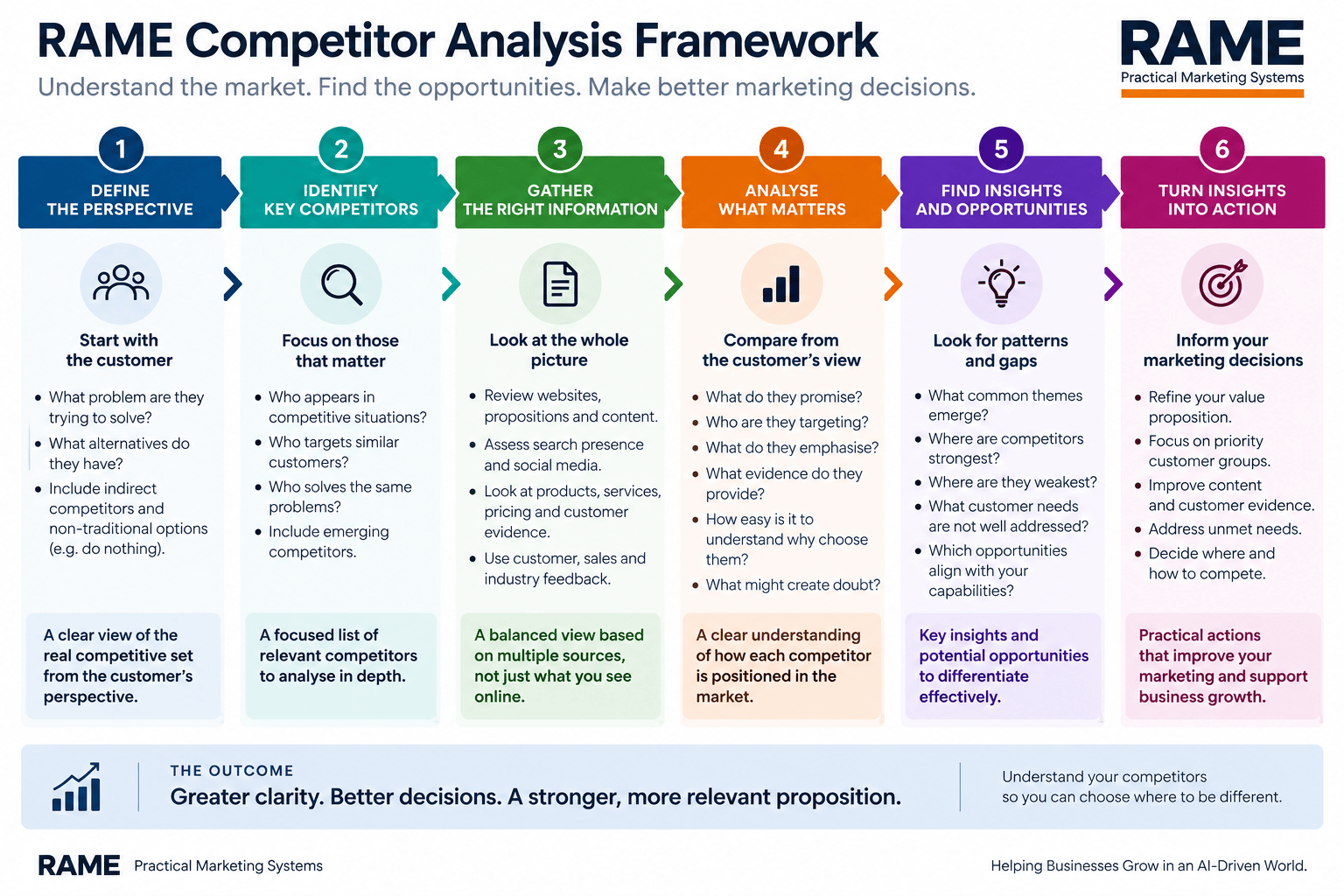
Compare What Matters to the Customer
A useful competitor comparison should focus on factors that influence buying decisions.
Depending on your market, these might include:
specialist expertise
product capability
service
responsiveness
availability
price
reliability
implementation support
geographical coverage
technical knowledge
customer experience
evidence and credibility
speed
flexibility
But don't assume which factors matter.
Use customer conversations, sales feedback, reviews and research to understand what customers genuinely value.
Then compare competitors against those criteria, rather than whatever information happens to be easiest to collect.
Find the Gaps
One of the most valuable outcomes of competitor analysis is identifying what isn't being addressed well.
Perhaps competitors all talk about product features but customers really care about implementation.
Perhaps everyone claims to provide excellent service but nobody explains what that actually means.
Maybe an important customer group is poorly served.
Perhaps the market has become dominated by complicated propositions and there is an opportunity to make the buying decision simpler.
A competitive gap doesn't automatically mean an opportunity.
It still needs to align with customer need and your own capability.
But it gives you somewhere useful to investigate.
Don't Try to Be Different for the Sake of Being Different
Businesses are frequently told they need to differentiate themselves.
That's true — but difference alone has little value.
You could make your business different tomorrow by introducing something customers don't care about.
Effective differentiation sits at the intersection of:
What customers value + What competitors don't provide particularly well + What your business can genuinely deliver
That's where competitor understanding becomes commercially useful.
The objective isn't simply to look different.
It's to give the right customers a relevant reason to choose you.
Competitor Analysis Should Influence Your Proposition
Once you understand your customers and competitors, revisit the way you present your business.
Ask:
What do customers value most?
Where are competitors strongest?
Where are they weakest?
What can we credibly claim?
What evidence supports that claim?
Why should our priority customer choose us rather than the alternatives?
If the answer is simply quality, service and competitive prices, you probably haven't gone far enough.
Those are things customers expect almost every business to claim.
A stronger proposition connects a meaningful customer need with something your business can demonstrably deliver.
AI Can Make Competitor Research Faster
AI can significantly reduce the time required to organise and analyse competitor information.
It can help you:
structure competitor research
compare propositions
identify recurring themes
summarise large amounts of information
analyse customer reviews
identify apparent gaps
generate questions for further investigation
But there is an important limitation.
AI can analyse the information available to it.
It doesn't automatically know which competitive differences actually matter to your customers.
Nor should an AI-generated competitor assessment be treated as fact without checking the underlying evidence.
Use AI to accelerate the analysis.
Use customer evidence, business knowledge and human judgement to decide what the analysis means.
Turn Competitor Research Into Decisions
The final output of competitor analysis shouldn't be a competitor report that sits in a folder.
It should improve decisions.
You might decide to:
change the way you describe your proposition;
focus more strongly on a particular customer group;
develop better evidence or case studies;
address a customer concern competitors overlook;
improve part of the customer experience;
stop competing primarily on price;
create content around poorly answered customer questions;
or investigate a new market opportunity.
That's when competitor research becomes valuable.
It changes what you do.
Competitor Analysis Is About Understanding Your Choices
Your competitors matter.
But they shouldn't determine your marketing strategy.
If you constantly react to what competitors are doing, they effectively begin making your marketing decisions for you.
Instead, understand them well enough to make your own choices with greater confidence.
Know what customers can choose.
Understand how those alternatives are positioned.
Identify what customers value.
Recognise where genuine opportunities exist.
Then decide where your business can compete most effectively.
Because the purpose of competitor analysis isn't to become more like your competitors.
It's to understand the market well enough to know where you should be different.
Continue Your Learning
Next Article
How to Improve Your Website Conversion Rate — Without Simply Driving More Traffic
Related Framework
Website & Search Performance Review
Related Learning Kit
Module 2 — The Marketing Review