
How to Identify Your Best Customers — and Why It Changes Your Marketing
Most businesses know who their customers are.
Far fewer know which customers they should be trying hardest to attract.
That distinction matters.
When businesses talk about their target customers, they often describe a very broad group: small businesses, manufacturers, homeowners, professional services firms, marketing managers or companies with more than 50 employees.
These descriptions may tell you who could buy from you. They don't necessarily tell you who represents the best opportunity for your business.
And if you don't know which customers matter most, almost every subsequent marketing decision becomes harder.
Your proposition becomes broader. Your messaging becomes less relevant. Your content tries to speak to everyone. Marketing budgets become spread across too many audiences and channels.
Better marketing starts with making choices.
And one of the most important is deciding which customers you most want to attract.
Your Best Customer Isn't Necessarily Your Biggest Customer
It's tempting to define a good customer purely by revenue.
But revenue is only part of the picture.
A large customer that requires significant support, continually negotiates on price, pays slowly and rarely buys anything else may be less commercially attractive than several smaller customers with healthy margins, repeat requirements and a strong fit with your business.
That's why customer value needs to be considered more broadly.
A valuable customer might:
generate good revenue and margin
buy repeatedly
have an ongoing requirement for what you provide
value the things your business does particularly well
be relatively straightforward to serve
have the potential to buy additional products or services
recommend you to other organisations
remain with you for a long time
The exact criteria will differ between businesses.
The important point is to stop thinking simply about who buys from us? and start asking which types of customers create the greatest value for the business?
Start With the Customers You Already Have
Businesses sometimes begin customer targeting by inventing an ideal customer persona.
There can be value in personas, but there is often a better starting point:
your existing customer base.
Your customers contain evidence.
Look at the customers you would genuinely like more of.
Which generate the strongest margins?
Which stay longest?
Which buy repeatedly?
Which are easiest to work with?
Which understand the value you provide?
Which products or services do they buy?
Why did they choose you?
What problems were they trying to solve?
How did they originally find you?
Patterns often begin to emerge.
You may discover that a market you've historically considered important generates considerable revenue but relatively poor margins.
Or that a smaller group of customers has quietly become highly profitable because they buy repeatedly and require relatively little support.
You might find that customers from one sector respond particularly strongly to a capability that you barely mention in your marketing.
That is useful marketing intelligence.
Look Beyond Demographics
Customer targeting often stops with characteristics such as industry, company size, location, age or job title.
Those characteristics can help you identify a market, but they don't necessarily explain why somebody buys.
Two companies of the same size in the same industry can have completely different needs.
One may be growing quickly and need additional capability.
Another may be trying to reduce costs.
One may already understand the problem it needs to solve.
Another may not yet recognise that it has a problem.
That's why useful customer understanding combines who the customer is with what is happening in their world.
Ask questions such as:
What are they trying to achieve?
What problems are preventing them from achieving it?
What triggers them to start looking for a solution?
What alternatives are they considering?
What concerns might prevent them from buying?
Who is involved in the decision?
What does a successful outcome look like to them?
Now you're beginning to understand the customer rather than simply describe them.
Understand the Difference Between the Customer and the Buyer
This is particularly important in B2B marketing.
The person who uses your product may not be the person who chooses it.
And the person who chooses it may not be the person who approves the expenditure.
Imagine a business selling technical equipment.
An engineer might recognise the need.
An operations manager might evaluate the solution.
A procurement manager might negotiate the purchase.
A managing director or finance director might approve the investment.
They are all connected to the same sale, but they don't necessarily care about the same things.
The engineer may focus on capability.
Operations may care about reliability and productivity.
Procurement may concentrate on commercial terms.
The managing director may want to understand the business case.
Good marketing recognises these differences.
Instead of trying to create one generic message for an organisation, understand the different people involved in the buying decision and what each needs to know.
Identify the Problems You Are Best Equipped to Solve
There is another side to identifying your best customers.
It's not only about finding attractive customers.
It's about finding the strongest fit between their needs and your capability.
Ask:
What problems are we particularly good at solving?
Where do we have genuine expertise?
Where can we create the greatest customer value?
Where do we have evidence that our approach works?
Which customers particularly value our strengths?
This is where customer understanding begins to connect with competitive positioning.
Your best market opportunity often exists where three things overlap:
Customer need + Commercial value + Your capability
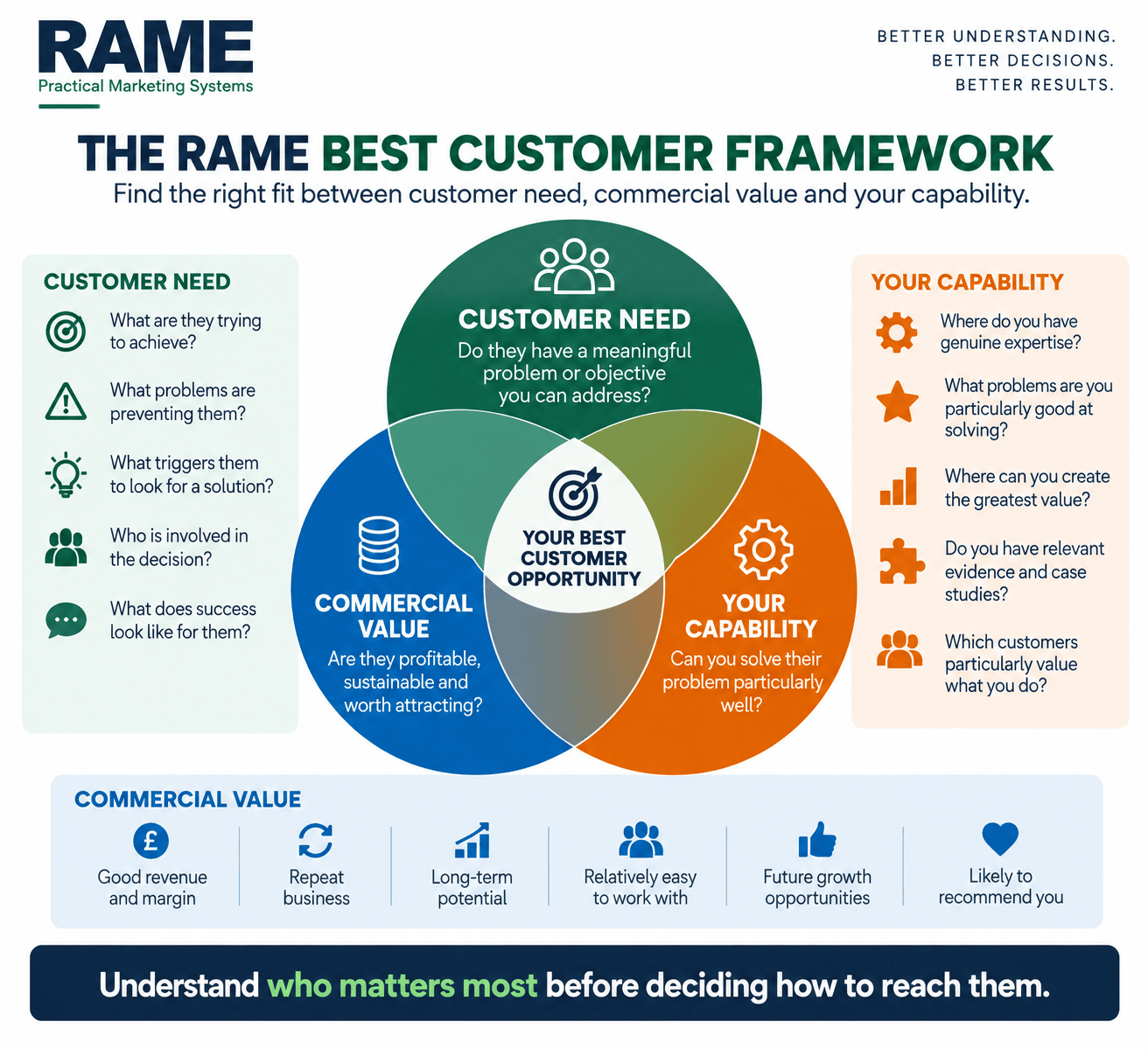
A customer might be commercially attractive, but if dozens of competitors are better equipped to serve them, it may not be your strongest opportunity.
Another group may be smaller but have a problem that fits your expertise extremely well.
That can be a much more attractive market.
Don't Confuse the Market With the Customer
This distinction is useful.
A market is the broader commercial opportunity.
A customer is the type of organisation or person within that market you want to attract.
For example, a business might identify advanced manufacturing as an attractive market.
But that still doesn't tell it which manufacturers to target.
The strongest opportunity might actually be:
UK advanced manufacturing businesses with 50–250 employees that are expanding production capacity and need to improve quality-control processes.
That is considerably more useful.
It begins to influence where you look for prospects, what problems you discuss, which evidence you provide and how you communicate your value.
Prioritisation Doesn't Mean Ignoring Everyone Else
Businesses sometimes resist targeting because they're worried about excluding potential customers.
But choosing your priority customers doesn't mean refusing to sell to anybody else.
It means deciding where to concentrate your marketing attention and resources.
If five different customer groups could buy from you but two represent significantly better opportunities, those two should probably receive more of your marketing investment.
That might influence:
the subjects you create content about
the case studies you develop
the events you attend
the search terms you target
the advertising audiences you build
the pages you create on your website
the propositions you emphasise
the sales conversations you prepare for
You can still accept business from elsewhere.
You're simply no longer expecting your marketing to treat every possible customer as equally important.
Better Customer Understanding Changes Your Marketing
Once you know who your priority customers are and what matters to them, marketing becomes much easier to connect.
Instead of asking:
What should we post on LinkedIn?
you can ask:
What does our priority customer need to understand before they will consider us?
Instead of:
What keywords should we rank for?
ask:
What is our customer searching for when they first recognise this problem?
Instead of:
What should our website say?
ask:
What does this customer need to see to believe we're capable of solving their problem?
Instead of:
Should we advertise?
ask:
Where can we reach the customers we've decided matter most?
These are much stronger marketing questions.
And they demonstrate an important RAME principle:
The tactic should follow the decision — not determine it.
AI Can Help — But Give It the Right Context
AI can make customer research considerably faster.
It can help analyse customer feedback, summarise interview notes, identify recurring themes, explore potential customer problems, compare segments and generate research questions.
But AI doesn't automatically know which customers are commercially valuable to your business.
It doesn't inherently know your margins, customer-retention patterns, operational constraints, strategic priorities or what you've learned from years of serving customers.
The quality of the analysis therefore depends heavily on the business context you provide.
Instead of asking:
Who are the ideal customers for an engineering company?
you might ask AI to help analyse anonymised information about your existing customer groups, purchasing patterns, profitability, common requirements and strategic priorities.
The second task gives AI something much more useful to work with.
AI can accelerate customer analysis. Your business knowledge determines what the analysis means.
A Simple Way to Start
You don't need a major research programme before improving your customer targeting.
Start with your existing customers.
Identify perhaps 10–20 that you would genuinely like more of.
Then look for common characteristics.
Consider their commercial value, needs, buying behaviour, reasons for choosing you and fit with your capabilities.
Talk to customer-facing employees.
Speak to customers where possible.
Look at CRM information, enquiries, sales records, customer feedback, website behaviour and search data.
Then compare what the evidence tells you with the assumptions you've been making.
You may confirm what you already believed.
But you may also discover that the customers you've historically marketed towards aren't necessarily the customers you should prioritise next.
Better Marketing Starts With Knowing Who Matters Most
You don't need everybody to become a customer.
You need enough of the right customers.
Understanding who those customers are makes it easier to develop a relevant proposition, create useful content, select appropriate channels, allocate budgets and make better marketing decisions.
Before asking how to reach more people, therefore, ask a more important question:
Who do we actually want to reach — and why?
Because when you understand your best customers, you don't just improve your targeting.
You improve the marketing decisions that follow.
Continue Your Learning
Next Article
How to Understand Your Competitors — and What Actually Matters
Related Learning Kit
Module 2 — The Marketing Review