
How to Know What to Improve First
Once you start reviewing marketing properly, an interesting problem often appears.
You discover more opportunities for improvement than you can realistically implement.
Your website could be improved. Your content needs updating. Lead follow-up could be stronger. Some campaigns are underperforming. Reporting needs attention. Your customer journey contains friction. SEO could be better. AI might improve efficiency.
The temptation is to create a very long action list.
But a long list isn't a strategy.
The real question is:
Which improvement should we make first?
Prioritisation matters because not every improvement creates the same value, requires the same resources or needs the same urgency. RAME's audit methodology deliberately separates important findings from lower-value tasks so resources can be focused where they are likely to have the greatest impact.
Start With the Evidence
Don't begin by asking:
“What would we like to improve?”
Start with:
“What does the evidence tell us needs improving?”
That evidence might come from:
Customer feedback.
Marketing performance data.
Website analytics.
Campaign results.
Sales conversations.
Search performance.
Conversion data.
Customer behaviour.
Competitor activity.
Your wider Marketing Review.
The distinction matters.
An improvement based on evidence addresses something you have reason to believe matters.
An improvement based primarily on opinion may simply reflect whoever has the loudest voice.
Separate Problems From Symptoms
Suppose website enquiries are falling.
The immediate conclusion might be:
“We need more website traffic.”
But falling enquiries are a symptom.
The underlying issue could be:
Traffic has fallen.
The wrong people are visiting.
Conversion rates have declined.
The offer isn't strong enough.
The customer journey contains friction.
Important pages aren't answering customer questions.
Calls to action aren't working.
Follow-up is too slow.
Before prioritising an improvement, try to understand what is actually causing the problem.
Otherwise, you risk improving the wrong thing.
Connect Improvements to Your Objectives
An improvement becomes more important when it supports something the business is already trying to achieve.
If your priority marketing objective is generating more qualified enquiries, improving a major conversion barrier may deserve more attention than redesigning an email template.
If customer retention is the priority, improving onboarding or customer communication may matter more than increasing website traffic.
Ask:
Which of our objectives would this improvement help us achieve?
If you can't make that connection, question whether it really belongs near the top of the list.
The RAME prioritisation material makes this explicit: high-impact opportunities should be considered alongside business goals, available resources and the balance between short- and longer-term improvements.
Consider Commercial Impact
Not all marketing improvements are commercially equal.
Fixing a problem affecting hundreds of potential customers could matter more than improving something seen by a handful.
Strengthening an important conversion page could matter more than redesigning a low-traffic page.
Improving lead qualification could matter more than simply generating additional leads.
So ask:
If we fix this, what difference could it make?
Consider its potential effect on:
Revenue.
Qualified leads.
Conversion.
Customer retention.
Customer experience.
Marketing efficiency.
Cost.
Risk.
Strategic capability.
You won't always be able to calculate the answer precisely.
You don't need to.
The purpose is to distinguish potentially significant improvements from things that would simply be nice to improve.
Consider Impact and Effort Together
A useful way to prioritise improvements is to consider two dimensions:
Impact — How much difference could this improvement make?
Effort — What will it take to implement?
Effort might include cost, internal resources, time and technical complexity. This impact-versus-effort approach already appears throughout the RAME audit material because it helps prevent businesses from treating every recommendation as equally important.
This creates four broad types of improvement:
High impact + low effort
Strong candidates for early action.
High impact + high effort
Important initiatives that probably need planning, budget or additional resources.
Low impact + low effort
Potentially worthwhile, but don't let them distract from more important work.
Low impact + high effort
Usually the weakest candidates for immediate attention.
This simple distinction can transform an overwhelming improvement list into something much more manageable.
Don't Automatically Choose the Easiest Tasks
Quick wins are useful.
They can create momentum, demonstrate progress and sometimes produce meaningful improvements with relatively little effort.
But there's a danger.
A marketing team can become very efficient at completing easy tasks that don't matter very much.
Ten minor improvements aren't necessarily more valuable than solving one significant problem.
So don't ask only:
“What can we do quickly?”
Also ask:
“What deserves to be done?”
Identify Dependencies
Some improvements can't happen until something else has been resolved.
You might want to create a new campaign, but first need to clarify the offer.
You might want to increase website traffic, but first need to fix conversion problems.
You might want to introduce marketing automation, but first need a clear lead-management process.
You might want to create more content, but first need to understand the audience and the questions they actually ask.
This means prioritisation isn't always about selecting the improvement with the highest score.
Sometimes you need to address the enabling improvement first.
Ask:
What needs to be true before we can successfully implement this?
Distinguish Corrective Actions From Strategic Decisions
This is particularly important.
Some improvements are straightforward corrections.
A broken link can be fixed.
An incorrect page title can be changed.
An outdated contact detail can be updated.
Other findings have wider implications.
Changing target markets.
Repositioning the business.
Replacing a major platform.
Changing the marketing budget.
Introducing a new channel.
Restructuring the customer journey.
Those shouldn't automatically become immediate actions simply because they appeared in an audit.
They require strategic, resource or investment decisions.
RAME's current audit methodology deliberately distinguishes immediate corrective issues from recommendations requiring strategic, budget or resource decisions.
That prevents an audit from accidentally becoming a strategy.
Look for Improvements That Strengthen Several Areas
Some improvements have a multiplier effect.
Improving your value proposition might strengthen:
Your website.
Sales conversations.
Campaigns.
Content.
Landing pages.
Email.
Customer understanding.
Similarly, improving your measurement system might help you make better decisions across multiple campaigns and channels.
These improvements deserve particular attention because they don't solve just one isolated problem.
They strengthen the marketing system.
Once you have identified the gaps, weaknesses and opportunities in your marketing, the next challenge is deciding what to improve first.
Not every issue deserves the same level of attention. Some improvements could have a significant impact but require substantial time or investment. Others may be relatively easy to implement but make very little difference.
A practical way to make that decision is to consider impact and effort together, while also looking at how closely each improvement supports your wider business and marketing priorities.
The RAME Marketing Improvement Prioritisation Framework below provides a simple process for doing this. It helps you move from a long list of possible improvements to a focused set of priorities — identifying quick wins, important projects and the areas that may not justify investment yet.
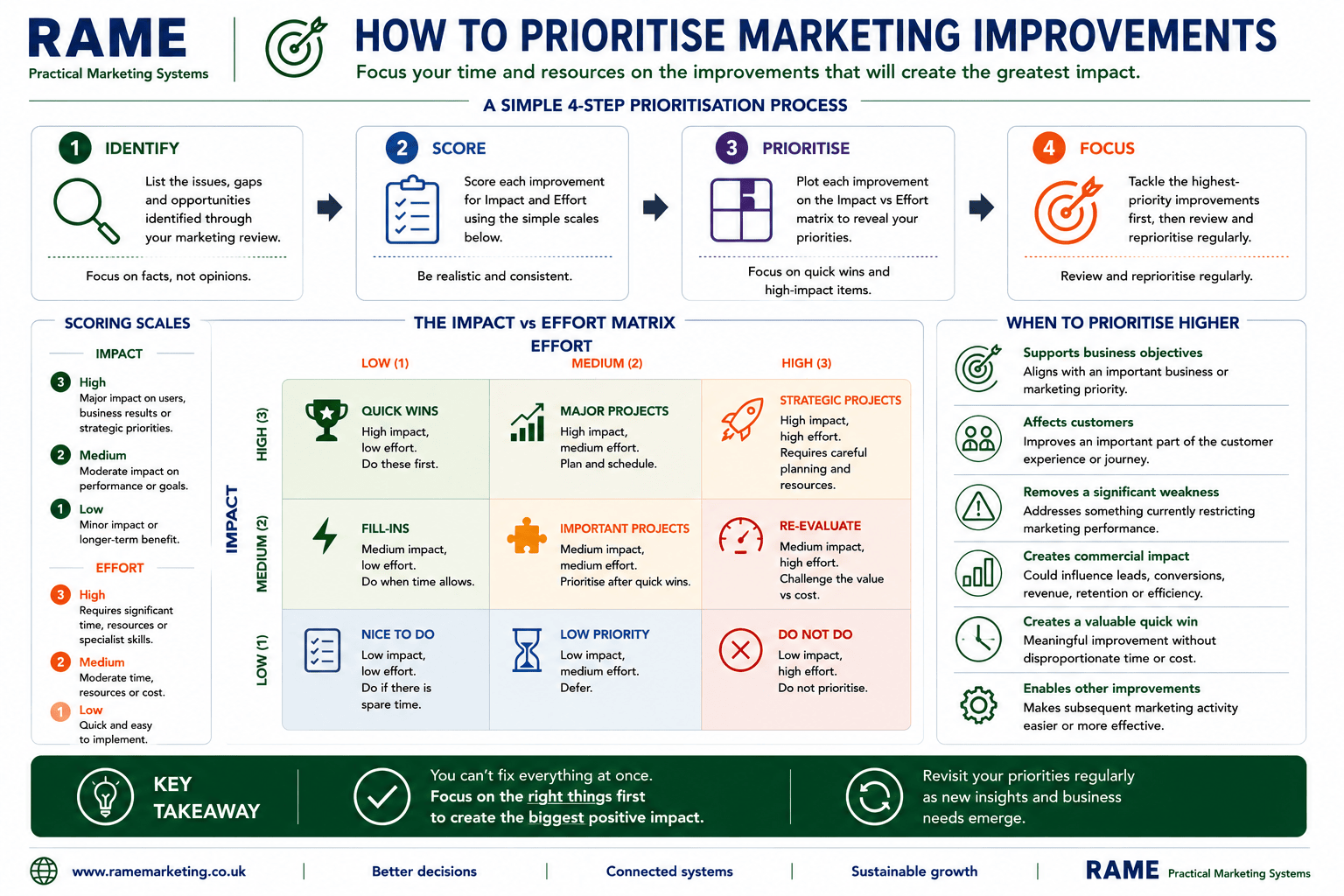
The purpose isn't simply to find the easiest things to fix. It is to identify the improvements that offer the best balance of potential impact, effort and strategic importance.
This is what turns a marketing review from a list of observations into a practical improvement plan.
Be Realistic About Resources
A high-impact opportunity isn't necessarily the right immediate priority if the business doesn't currently have the resources to deliver it properly.
Consider:
Time.
Budget.
Skills.
Technology.
External support.
Internal capacity.
Dependencies.
Other business priorities.
This isn't an excuse for avoiding difficult improvements.
It's about turning priorities into something that can actually be implemented.
RAME's prioritisation approach specifically balances potential impact with implementation effort and available resources.
Choose a Small Number of Priorities
Once you've assessed the opportunities, reduce the list.
You might have identified 25 possible improvements.
You don't need 25 priorities.
Choose the few that matter most.
For example:
Priority 1 — Fix a major website conversion barrier
Priority 2 — Improve lead follow-up
Priority 3 — Strengthen content around a high-value customer need
Everything else doesn't disappear.
It simply isn't the priority right now.
This protects resources and reduces one of the warning signs identified repeatedly in the RAME material: too many simultaneous projects competing for attention.
Give Every Priority an Owner
A priority without ownership often remains an intention.
Once you've decided what matters most, establish:
What needs to happen.
Who owns it.
When it should happen.
What resources are required.
How success will be measured.
This is the point where analysis becomes action.
The RAME priority-planning material consistently combines the improvement itself with impact, effort, priority and ownership rather than treating prioritisation as an abstract exercise.
Use AI to Help Prioritise — Not to Make the Decision
AI can be particularly useful when you have a large number of findings.
You can ask it to:
Group related issues.
Identify recurring themes.
Separate symptoms from possible underlying causes.
Compare potential impact.
Identify dependencies.
Highlight quick wins.
Separate corrective actions from strategic issues.
Challenge your assumptions.
Suggest questions you should investigate before deciding.
For example:
“Review these marketing improvement opportunities. Group related issues, identify likely dependencies and help me assess each one according to potential business impact, implementation effort and alignment with our current marketing objectives. Do not choose the final priorities until you have asked me about our resources and commercial priorities.”
The final decision should remain yours.
AI can structure the evidence.
Human judgement determines what matters most.
A Simple Priority Test
Before making an improvement a priority, ask six questions:
Evidence — What evidence tells us this needs attention?
Objective — Which business or marketing objective does it support?
Impact — What meaningful difference could it make?
Effort — What will it cost in time, money and resources?
Dependency — Does something else need to happen first?
Timing — Why should we do this now rather than later?
You don't need a complicated scoring model.
The purpose is to make the decision deliberately rather than reactively.
Prioritisation Is Part of Continuous Improvement
Continuous improvement doesn't mean fixing everything.
It means repeatedly identifying what matters most now.
Measure.
Learn.
Identify opportunities.
Prioritise.
Improve.
Measure again.
Then priorities may change because your starting point has changed.
That is exactly what the RAME Improvement Cycle is designed to represent.
The goal isn't to reach the end of an improvement list.
It is to develop a marketing system capable of identifying and acting on the right improvements over time.
Continue Your Learning
Next Article
How to Build a 90-Day Marketing Improvement Plan
Related Framework
Marketing Priority Matrix
Related Learning Kit
Module 2 – The Marketing Review