
How to Improve Your Marketing Continuously
Marketing is never finished.
Markets change. Customers change. Competitors change. Technology changes. New channels appear. Artificial Intelligence continues to create new capabilities.
Your own business changes too.
That means a marketing system that works well today may need to evolve tomorrow.
But continuous improvement does not mean constantly starting again.
In fact, it means the opposite.
A strong marketing system gives you a stable foundation that you can review, learn from, refine and strengthen over time. The RAME Philosophy makes this point directly: improvement should help a business adapt without abandoning everything it has already built.
Improvement Starts With Evidence
The previous article looked at measuring marketing performance.
Measurement only creates value when you act on what you learn.
Suppose your data shows:
A landing page is attracting visitors but converting poorly.
An email sequence is generating strong engagement.
One customer segment is producing better-quality enquiries.
A particular article consistently attracts the right prospects.
A campaign channel is consuming budget without producing sufficient value.
Those observations are useful because they suggest what might deserve attention next.
The purpose of continuous improvement is not to react to every number.
It is to use evidence and judgement to decide where an improvement could create the greatest value.
RAME describes the process simply: decisions create action, action creates evidence, evidence creates learning and learning improves the next decision.
Don't Confuse Improvement With More Activity
Businesses often respond to disappointing marketing by adding something.
More social media.
Another campaign.
More content.
Another advertising channel.
A new tool.
A new supplier.
More automation.
Sometimes that is appropriate.
But improvement can also mean:
Removing unnecessary activity.
Simplifying a process.
Improving a landing page.
Refining a value proposition.
Strengthening an existing article.
Improving an email sequence.
Fixing a weak point in the customer journey.
Repurposing a successful asset.
Changing how leads are followed up.
Making reporting easier to understand.
Improvement doesn't automatically mean more.
Sometimes the best improvement is making what already exists work better. That principle is explicit in the RAME Philosophy: some elements should change, while others should be retained, refined or strengthened.
Look for the Weakest Connection
Marketing operates as a connected system.
That means a problem in one part of the system can affect several others.
Imagine a business is generating good website traffic but few enquiries.
The immediate response might be:
“We need more traffic.”
But the real problem might be conversion.
Or messaging.
Or the offer.
Or the call to action.
Or the quality of the audience being attracted.
Improvement therefore starts by understanding where the system is breaking down.
Ask:
Where are prospects disengaging?
Where is activity producing weak outcomes?
Where are teams repeatedly encountering problems?
Which assets are underperforming?
Where does customer feedback suggest friction?
Which process consumes disproportionate time?
Which improvement could strengthen several other activities at once?
The aim is to improve the system, not simply the most visible symptom.
Protect What Is Already Working
Continuous improvement shouldn't become continuous disruption.
If something is performing well, understand why before changing it.
Perhaps a particular content format consistently attracts valuable prospects.
Perhaps one market segment converts particularly well.
Perhaps customers respond strongly to a certain message.
Perhaps a specific nurture sequence works.
Those are useful assets.
Improvement might mean extending or strengthening them rather than replacing them.
This is particularly important because marketing teams can become attracted to novelty.
A new platform may look more exciting than refining something proven.
But progress often comes from building on what already works.
Make Small Improvements Deliberately
Not every improvement needs to be transformational.
Small improvements can compound.
A clearer headline.
A better call to action.
A simpler form.
An improved follow-up email.
A stronger case study.
A better-targeted campaign.
A faster internal approval process.
A more useful KPI.
A clearer piece of customer guidance.
Individually, each may seem modest.
Collectively, they can strengthen the whole marketing system.
The existing RAME continuous-improvement material captures this succinctly: small improvements compound over time.
That makes continuous improvement more manageable.
You don't need to redesign everything.
You need to keep identifying the next worthwhile improvement.
Build a Regular Review Rhythm
Improvement becomes easier when it is part of normal marketing management rather than something triggered by a crisis.
Different questions can be reviewed at different intervals.
Monthly, you might look at campaign performance, KPIs, content performance and obvious conversion problems.
Quarterly, you might step back and review strategy, priorities, customers, the competitive environment and the performance of the wider marketing system.
The exact schedule will vary.
The important thing is establishing a rhythm.
RAME's own continuous-improvement framework combines regular KPI and content reviews with periodic strategy, priority and KPI reassessment.
A business that reviews marketing consistently is less likely to wait until the pipeline weakens before asking whether something needs to change.
Continuous improvement works best when it follows a repeatable process. The RAME Improvement Cycle shows how evaluation and analysis lead to clearer priorities, better decisions and focused improvements that strengthen the marketing system over time.
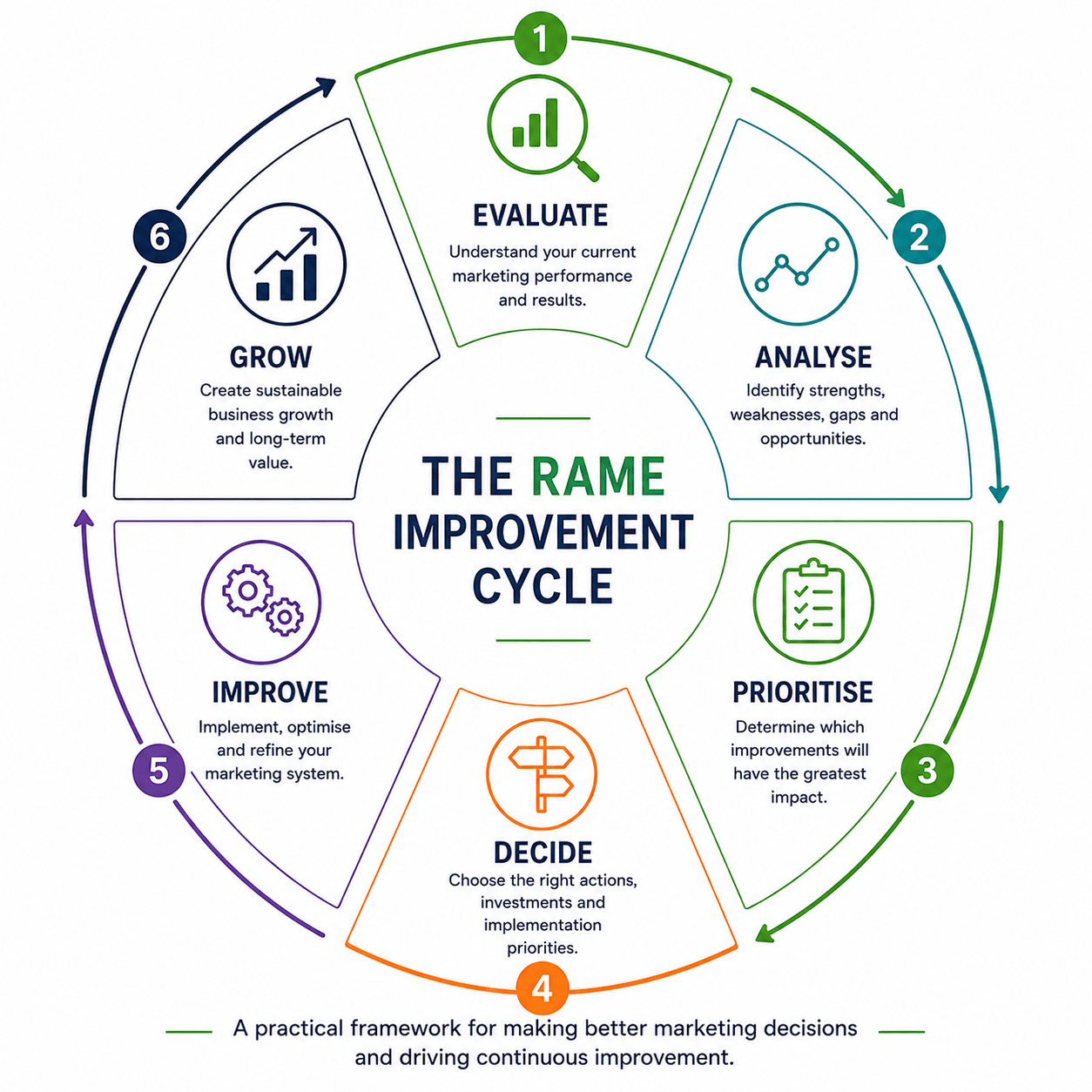
The cycle then begins again. What you improve creates new evidence, and that evidence helps you understand what should be strengthened next.
Capture What You Learn
Marketing experience is valuable.
But only if the organisation retains it.
After a campaign, record:
What worked.
What didn't.
What surprised you.
What customers responded to.
Which assumptions proved wrong.
What should be repeated.
What should be changed.
What should be stopped.
If those lessons aren't captured, teams can end up repeatedly rediscovering the same answers.
RAME treats this learning as an asset in its own right: capturing lessons helps prevent organisations from repeatedly relearning them and allows experience to inform future decisions.
Over time, this creates organisational marketing knowledge.
Improve Assets Instead of Constantly Replacing Them
Many marketing assets can become more valuable through continued improvement.
An article can be updated.
A landing page can be tested.
A case study can be strengthened.
A guide can be repurposed.
An email sequence can be refined.
A sales presentation can incorporate better customer evidence.
A website page can answer more of the questions prospects actually ask.
These aren't disposable activities.
They're assets.
RAME deliberately treats marketing assets as things that should become more valuable through continued use and improvement rather than continually being replaced.
This is one of the ways marketing investment begins to compound.
Use Testing Carefully
Testing can support continuous improvement.
You might test:
Different headlines.
Calls to action.
Offers.
Landing-page layouts.
Email subject lines.
Content formats.
Campaign audiences.
Follow-up sequences.
But testing only helps if the result influences a decision.
Running endless experiments without a clear question simply creates more activity.
Start with a hypothesis.
For example:
“We believe shortening this form will increase qualified completions.”
Make the change.
Measure what happens.
Then decide what you've learned.
Testing should reduce uncertainty — not become another marketing habit performed without purpose.
AI Can Accelerate Improvement
AI can make continuous improvement easier.
It can help:
Analyse performance data.
Identify patterns.
Summarise customer feedback.
Compare different periods.
Spot anomalies.
Review content.
Suggest possible improvements.
Generate alternatives.
Document lessons.
Identify repetitive processes that might be automated.
But AI still needs context.
It might identify a declining metric without understanding that the business deliberately changed strategy.
It may recommend increasing activity where the more sensible decision is to stop it.
So use AI to help surface possibilities and accelerate analysis.
Keep commercial judgement responsible for deciding what deserves action.
Know When Not to Change
Continuous improvement also requires restraint.
Not every fluctuation requires action.
Not every competitor move should be copied.
Not every new AI capability needs adopting.
Not every new channel deserves investment.
Marketing data contains noise.
Short-term results vary.
Some strategies need time.
The skill is distinguishing between:
A genuine signal.
A temporary fluctuation.
A structural change.
And an attractive distraction.
That is why RAME emphasises having enough structure to create consistency while remaining adaptable. Consistency is not standing still; it is having a dependable way to respond intelligently to change.
Improvement Creates the Next Starting Point
Continuous improvement is cyclical.
You understand the current situation.
You make decisions.
You build.
You implement.
You measure.
You improve.
Then what you have learned changes your understanding of the situation.
So the cycle begins again — but from a stronger starting point.
The RAME Framework describes this as:
Understand → Decide → Build → Implement → Measure → Improve
The stages form a continuous process in which measurement and improvement feed the next round of understanding and decision-making.
That is an important distinction.
You are not going back to the beginning.
You are starting the next cycle with more evidence, better assets and more experience.
Progress Beats Perfection
Marketing will never be perfect.
There will always be something else you could improve.
The goal is therefore not perfection.
It is progress.
Consistent execution.
Regular measurement.
Useful learning.
Focused improvement.
Then repeat.
RAME's planning material summarises the idea well: progress rarely comes from perfection; it comes from consistent action, learning, testing and improvement.
You don't need to rebuild your marketing every year.
You need a system capable of learning and becoming stronger over time.
Continue Your Learning
Next Article
How to Know What to Improve First
Related Framework
Continuous Improvement Framework
Related Learning Kit
Module 5 – Delivering Your Marketing Plan