
How to Build a 90-Day Marketing Plan
Marketing plans often fail for a simple reason: they try to do too much.
A long list of campaigns, channels, content ideas and improvement projects can look impressive on paper, but it can quickly become difficult to implement — particularly when marketing is only one of many responsibilities competing for time and resources.
A 90-day marketing plan provides a more practical alternative.
Instead of trying to plan everything for the next year in detail, it turns your marketing priorities into a focused programme of activity that can be implemented, measured and reviewed over a manageable period.
The objective isn't to squeeze an entire marketing strategy into three months.
It is to decide what matters most now, take action and create a structured point at which to review what happens next.
Why 90 Days Works
Marketing requires both direction and adaptability.
Plan too little and marketing becomes reactive. Decisions are driven by whatever feels urgent that week.
Plan too far ahead in excessive detail and assumptions can quickly become outdated.
A 90-day period provides enough time to make meaningful progress while remaining short enough to review and adapt.
It also creates a useful rhythm:
Prioritise → Act → Measure → Learn → Improve
This is important because marketing improvement rarely comes from one dramatic change. It comes from consistently improving the activities that matter most, measuring progress and building on what you learn.
Start With Your Marketing Objectives
A 90-day plan should not begin with a list of tactics.
Start by asking:
What are we trying to achieve?
Your marketing objectives provide the connection between the wider needs of the business and the activities you choose to undertake.
For example, if the business needs to generate more qualified sales opportunities, the plan might focus on improving website conversion, strengthening relevant content and creating a better follow-up process.
If the objective is to improve customer retention, a completely different set of priorities may emerge.
The activities follow the objective — not the other way around.
Identify What Needs to Improve
Before deciding what you are going to do over the next 90 days, look at what you already know about your marketing.
Your review may have identified weaknesses or opportunities across areas such as:
marketing strategy, website performance, SEO, content, social media, email, paid advertising, analytics, AI adoption or the customer journey.
The temptation is to turn every finding into an action.
Don't.
A useful 90-day plan is deliberately selective. The RAME workbook asks users to identify their top three priorities rather than attempting to address everything simultaneously.
Decide What to Improve First
This is where the previous Knowledge Centre article, How to Know What to Improve First, becomes important.
Consider each potential improvement in terms of:
Impact — how much difference could it make?
Effort — what time, money or resources will it require?
Strategic importance — how closely does it support your objectives?
Evidence — what information suggests this really needs attention?
The purpose is not simply to find the easiest tasks.
It is to identify the improvements that deserve attention now.
Once you have done that, you can begin turning priorities into a 90-day sequence.
Once you have identified your priorities, the next step is to turn them into a realistic sequence of action.
Rather than trying to tackle everything immediately, a 90-day roadmap allows you to build momentum in stages — starting with quick wins, progressing to larger improvements, and then using the results to decide what should happen next.
The RAME 90-Day Marketing Improvement Roadmap provides a simple structure for doing this.
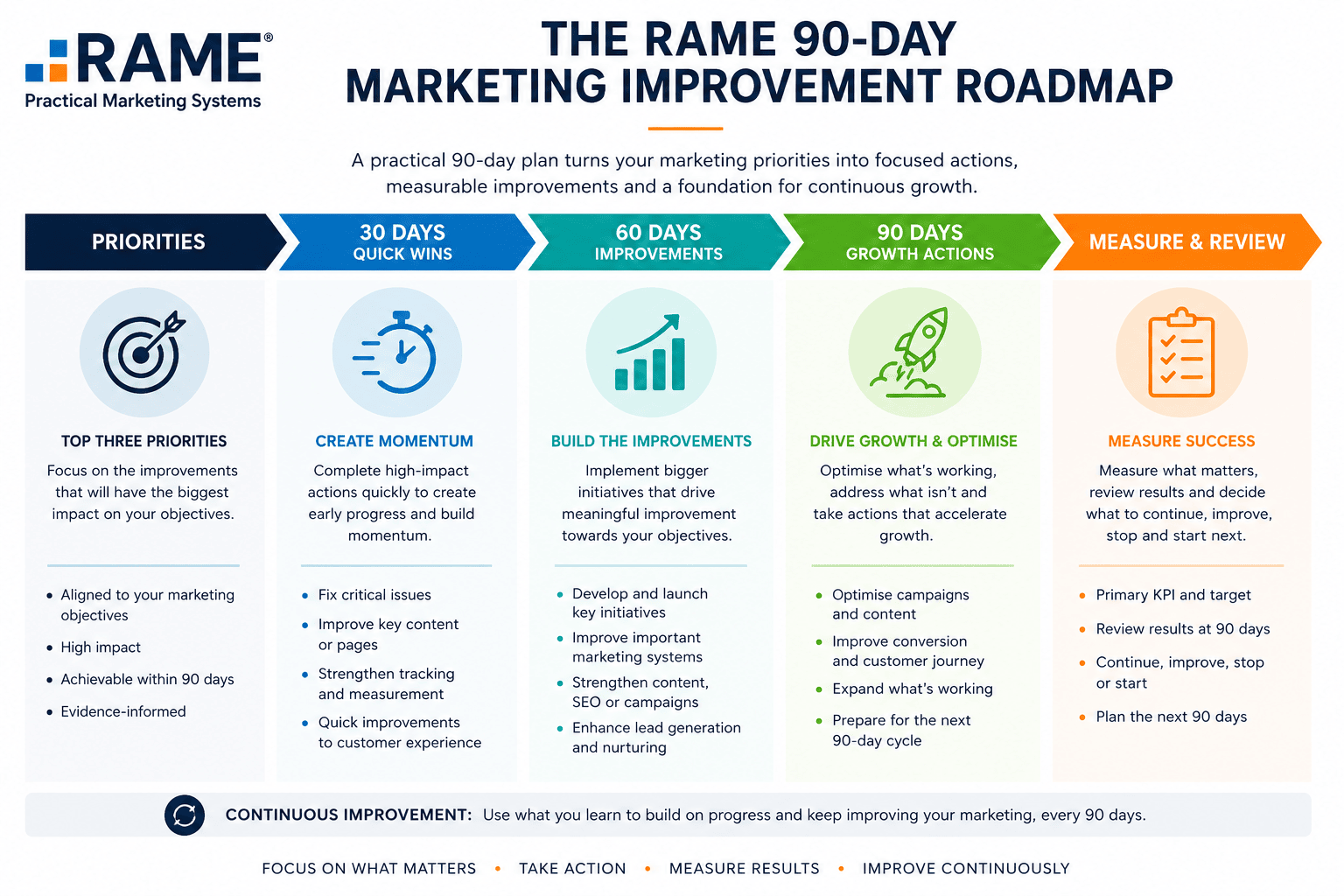
Days 1–30: Create Momentum
The first 30 days should include improvements you can begin — and ideally complete — relatively quickly.
These are your quick wins.
They might include improving an important website page, fixing a conversion problem, improving campaign tracking, updating an important piece of content or correcting a weakness in your customer journey.
The RAME roadmap treats these separately from larger initiatives because early progress creates momentum while longer-term work is being developed.
But avoid filling the first month with trivial tasks simply because they are easy.
A quick win should still contribute to an important objective.
Days 31–60: Build the Bigger Improvements
The next stage is where more substantial improvements can begin to take shape.
These are activities that require more work, coordination or resources than the initial quick wins.
For example, you might:
develop a new content resource, improve an important section of your website, build an email nurture sequence, strengthen your search presence or improve the connection between marketing and sales.
The important principle is that these shouldn't be disconnected projects.
Each should contribute to the priorities established at the beginning of the plan.
Days 61–90: Improve and Consolidate
By the final stage, you should have evidence from the work already undertaken.
Now the emphasis begins to shift from simply doing to learning and improving.
What has changed?
What appears to be working?
What isn't?
What should be improved further?
What should be stopped?
What deserves more investment?
The RAME approach explicitly brings measurement back into the 90-day roadmap, with a primary KPI and a target outcome used to judge whether marketing has actually improved.
This prevents the plan becoming nothing more than a completed task list.
Give Every Action an Owner and a Date
A marketing priority without ownership can easily remain a good intention.
For each significant action, establish:
What needs to happen?
Who owns it?
When should it be completed?
The RAME 90-Day Marketing Improvement Roadmap uses these three fields across the 30-, 60- and 90-day stages.
This is a simple distinction, but an important one.
A plan describes what you intend to do.
Ownership turns intention into accountability.
Decide How You Will Measure Success
Before implementation begins, decide how you will know whether the plan has made a difference.
The right measures will depend on the objectives.
They could include qualified enquiries, conversion rates, organic traffic, sales opportunities, customer retention, cost per lead or another KPI directly connected with the outcome you are trying to influence.
Don't measure something simply because the data is available.
Ask:
What evidence would tell us whether this priority is actually improving?
Then establish a starting point and the outcome you would like to see after 90 days.
Your 90-Day Plan Is Not the End
Day 90 should not be treated as the finishing line.
It is a review point.
At the end of the period, evaluate what happened and decide:
Continue — what is working and should continue?
Improve — what shows promise but needs refinement?
Stop — what isn't producing sufficient value?
Start — what new priority has emerged?
This creates the foundation for the next 90-day cycle.
Over time, marketing becomes less dependent on isolated campaigns and reactive decisions and more focused on a repeatable process of implementation, measurement and improvement.
Keep the Plan Focused
The purpose of a 90-day marketing plan isn't to capture everything your business could possibly do.
It is to make sure the right things actually get done.
Choose a small number of priorities.
Connect them to your objectives.
Give actions clear ownership.
Measure what matters.
Then use what you learn to decide what happens next.
That is how a 90-day plan becomes more than a short-term task list. It becomes part of a continuous marketing improvement system.
Continue Your Learning
Next Article
How to Identify Your Best Customers — and Why It Changes Your Marketing
Related Framework
90-Day Marketing Improvement Roadmap
Related Learning Kit
Module 1 — Building Your Modern Marketing System