
AI can help businesses produce more marketing content, complete tasks faster and automate routine activities. But greater productivity doesn't automatically mean better marketing. The important question is whether AI is improving decisions, reducing wasted effort and helping your business achieve better commercial results.
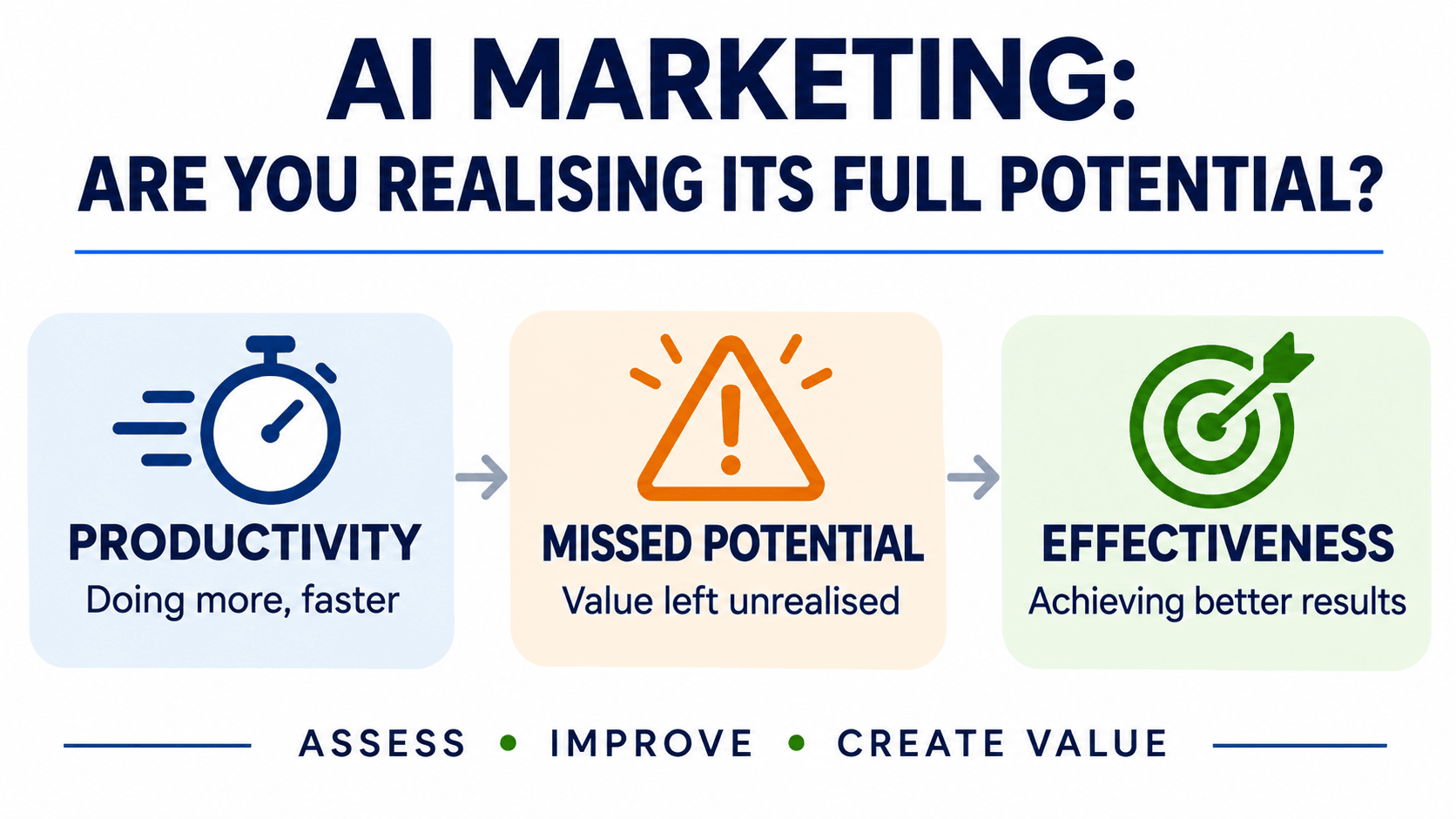
The Difference Between Marketing Productivity and Effectiveness
Artificial intelligence is changing how businesses carry out marketing.
Research that once took hours can be completed in minutes. Content can be drafted quickly. Campaign ideas can be generated almost instantly. Reports can be summarised, customer information analysed and repetitive processes automated.
For smaller businesses with limited marketing resources, these capabilities are attractive.
But there is an important distinction.
Marketing productivity measures how efficiently work gets done. Marketing effectiveness measures whether that work achieves worthwhile results.
A business might use AI to produce twice as many social media posts, publish more articles or generate more campaign ideas.
That doesn't necessarily mean it will attract more suitable customers, generate better enquiries or increase sales.
In some circumstances, it may simply become more efficient at producing marketing activity that isn't working.
The opportunity is to use AI to improve the performance of the marketing system, not just accelerate its activities.
1. Are You Producing More Marketing Without Achieving Better Results?
One of AI's most immediate benefits is the ability to produce content and marketing materials quickly.
A business can create social media posts, email drafts, website copy and campaign variations in a fraction of the time previously required.
That sounds like progress.
But consider a business that previously published two social media posts each week and now publishes ten using AI.
Its marketing output has increased fivefold.
What happens if enquiries, customer engagement and sales remain unchanged?
The business has improved production efficiency, but there is little evidence that its marketing has become more effective.
It may even be creating additional work through reviewing, scheduling and managing content that delivers limited value.
Before increasing activity, ask:
Is this activity reaching the customers we want to attract?
Does it address something those customers genuinely need?
Is it helping people understand why they should choose our business?
Is it generating meaningful engagement, enquiries or opportunities?
Would improving the quality or relevance of our existing activity produce better results than increasing its volume?
More marketing isn't necessarily better marketing.
AI creates greater value when it helps businesses identify which activities deserve attention, rather than simply making every activity easier to produce.
2. Is AI Improving the Quality of Your Marketing Decisions?
Marketing involves making choices.
Which customers should we prioritise?
Where should we invest our limited budget?
Which products or services offer the greatest growth opportunity?
Why are enquiries declining?
What should we change about our website?
AI can support these decisions by organising information, comparing alternatives, identifying patterns and helping businesses explore different scenarios.
However, AI-generated recommendations are only as useful as the information, assumptions and context behind them.
Imagine a business asking an AI tool to recommend its next marketing campaign.
The tool might produce a convincing campaign plan, complete with channels, messages and suggested activities.
But does it understand the business's most profitable customers?
Does it know which services have spare capacity?
Does it understand why existing customers buy, what competitors offer or which marketing activities have previously failed?
Without that information, the plan may look professional while offering limited commercial value.
A more effective approach is to use AI to support a structured decision-making process.
Start with the business objective. Provide relevant customer and performance information. Explore alternatives. Challenge assumptions. Then apply experienced judgement before deciding what to do.
The value isn't simply receiving an answer faster. It's reaching a better-informed decision.
3. Is AI Reducing Marketing Costs — or Creating More Work?
Reducing costs is one of the strongest reasons for adopting AI.
Used appropriately, AI can reduce the time required for research, reporting, drafting, administration and routine marketing processes.
But the financial benefit isn't always straightforward.
A business may save three hours producing a report, only to spend two hours correcting inaccuracies, checking sources and reworking the conclusions.
Another may introduce several AI subscriptions without understanding whether the tools duplicate capabilities it already has.
A third might produce more marketing material because it has become easier, increasing the time spent reviewing and managing content.
The important question is whether AI reduces the total effort and cost required to achieve a useful outcome.
Consider three possible improvements:
Example A — Reporting
A marketing manager previously spent four hours preparing a monthly performance report.
AI reduces the initial preparation to one hour, with another hour required for checking and interpretation.
The business saves two hours each month while maintaining report quality.
That is a measurable productivity improvement.
Example B — Content production
AI reduces the time needed to draft an article from four hours to one.
However, the article still requires research verification, editing and review, and generates no meaningful customer interest.
The business has reduced production time, but the commercial benefit remains uncertain.
Example C — Customer insight
AI helps a business analyse customer enquiries and identify recurring questions that its website fails to answer.
The business improves the relevant pages and subsequently sees an increase in suitable enquiries.
Here, AI has supported a change that may improve marketing effectiveness. The business should still check its performance data to establish whether the improvement is sustained and what contributed to it.
These examples illustrate an important distinction.
Time saved is valuable, but time saved and reinvested in better marketing decisions can be more valuable still.
4. Do Your People Have the Capability to Use AI Effectively?
Access to AI tools doesn't automatically create AI capability.
Two businesses can use the same technology and achieve very different results.
One may treat AI as a quick way to generate content.
Another may integrate it into research, planning, customer understanding, reporting and continuous improvement.
The difference often lies in the people, processes and management practices surrounding the technology.
Effective AI use requires several capabilities.
Marketing knowledge
People need to understand marketing objectives, customers, positioning, channels and performance to recognise whether AI-generated recommendations make sense.
Critical evaluation
AI outputs need to be checked for accuracy, relevance, completeness and commercial suitability.
Process design
Businesses need to decide where AI fits into existing workflows, what information it requires and which activities remain under human control.
Quality assurance
Someone must take responsibility for reviewing important outputs, protecting confidential information and maintaining appropriate brand standards.
Performance measurement
Businesses need a practical way to assess whether AI is delivering worthwhile improvements.
Without these capabilities, AI may increase activity while introducing inconsistency, errors and unnecessary complexity.
For SMEs, this doesn't necessarily mean employing AI specialists or investing in expensive systems.
It means developing enough knowledge, discipline and oversight to use the tools effectively.
5. Are You Measuring What AI Actually Contributes?
Many businesses can describe how they are using AI.
Fewer can explain what difference it has made.
The number of AI tools adopted, prompts written or pieces of content generated tells us little about commercial effectiveness.
A more useful assessment considers three levels of value.
Level 1 — Operational efficiency
Has AI helped the business work more efficiently?
Possible measures include:
Hours saved on recurring tasks.
Reduced external production costs.
Faster reporting or research.
Less repetitive administration.
Shorter turnaround times.
These improvements can create worthwhile savings, provided quality is maintained.
Level 2 — Marketing capability and quality
Has AI improved how marketing work is carried out?
Look for:
More consistent marketing processes.
Better use of customer and performance information.
Improved research and analysis.
Stronger briefs and more relevant content.
Better quality control.
More informed prioritisation.
These improvements may not immediately appear in sales figures, but they can strengthen the business's ability to deliver effective marketing.
Level 3 — Commercial outcomes
Is AI contributing to better business results?
Depending on the marketing objective, relevant measures might include:
More suitable enquiries.
Improved website conversion.
Lower customer acquisition costs.
Better campaign returns.
Increased customer retention.
Higher-value sales opportunities.
Reduced wasted marketing expenditure.
Commercial results are influenced by many factors, so businesses should avoid attributing every improvement to AI.
Where possible, compare performance before and after a change, consider other influences and look for consistent evidence.
The objective isn't to prove that AI is responsible for everything.
It's to understand whether using AI is helping the business achieve worthwhile results.
6. Is AI Supporting Your Marketing System — or Becoming Another Isolated Activity?
A common marketing problem is the lack of connection between activities.
The website operates separately from campaigns.
Content is produced without a clear relationship to customer needs.
Marketing reports contain data but don't influence decisions.
Sales feedback isn't consistently used to improve marketing.
Introducing AI into each activity independently doesn't necessarily solve these problems.
It may simply accelerate the disconnected processes that already exist.
A more valuable opportunity is to use AI across the marketing system.
For example:
Customer enquiries reveal recurring questions and concerns.
AI helps organise and analyse those enquiries.
The findings inform website improvements and marketing messages.
Relevant content addresses the questions customers are asking.
Campaigns direct suitable prospects towards that content.
Performance information helps identify what is working and what needs to change.
AI supports the flow of information and analysis between activities.
People remain responsible for interpreting the findings, deciding priorities and implementing improvements.
This is consistent with RAME's approach to building connected marketing systems.
AI should strengthen the relationships between marketing activities, not become another disconnected tool or initiative.
A Practical AI Marketing Effectiveness Check
Before investing in additional AI tools or expanding existing use, consider the following questions.
QuestionWhat to look for1. Are we clear about why we're using AI?Defined business or marketing problems, rather than technology adoption for its own sake.2. Do we know which activities AI should improve?Specific processes where better speed, quality or insight would create value.3. Are we measuring the benefits?Evidence of time savings, cost reductions, quality improvements or better outcomes.4. Do our people have the necessary skills?Marketing knowledge, AI understanding and the ability to evaluate outputs.5. Are responsibilities and quality controls clear?Defined ownership, review processes and appropriate safeguards.6. Is AI connected to our wider marketing activities?Information and insights flowing between research, planning, delivery and measurement.7. Are we learning from experience?Regular assessment of what works, what doesn't and what should change.
If several answers are unclear, the priority may not be another AI subscription.
It may be to review how AI is currently being used and identify where changes would create the greatest benefit.
What Should Your Business Do Next?
Businesses are at different stages of AI adoption.
Some are experimenting with tools and trying to understand what they can achieve.
Others have identified opportunities but aren't sure how to introduce AI into their marketing processes.
Some already use AI extensively but want to improve the quality, consistency and commercial value of their work.
Whatever the starting point, a practical improvement process follows the same principles.
Understand the current position.
Identify where AI is being used, why it was introduced and what it currently contributes.
Identify worthwhile opportunities.
Look for activities where better information, reduced effort, improved quality or stronger processes could make a meaningful difference.
Assess capability and risks.
Consider the knowledge, responsibilities, information and controls needed to use AI effectively.
Prioritise improvements.
Choose a manageable number of changes with clear objectives and realistic expectations.
Measure and improve.
Review the results, refine the processes and expand the applications that demonstrate value.
The aim isn't to use AI everywhere.
It's to use AI where it can make marketing more effective.
Better Marketing, Not Simply Faster Marketing
AI offers businesses significant opportunities to improve productivity, strengthen marketing capability and make better use of information.
But speed alone isn't a measure of success.
A business can produce more content, analyse more information and automate more processes without becoming any more effective at attracting, winning or retaining customers.
The greater opportunity comes from combining AI capabilities with marketing knowledge, customer understanding, clear processes and sound commercial judgement.
That means asking a different question.
Not simply:
“How much faster can AI help us work?”
But:
“How can AI help us make better decisions, reduce wasted effort and achieve better marketing results?”
The businesses that answer that question are more likely to turn AI from an interesting technology into a useful marketing capability.
Need an Independent Assessment of Your Marketing Capability and AI Use?
RAME's Marketing Capability & AI Review examines how your business organises and delivers marketing, including its people, processes, responsibilities and use of AI.
It identifies practical opportunities to improve marketing quality, efficiency and effectiveness, helping you decide where to focus your improvement efforts.
Fixed fee: £795. Delivered remotely, with no meetings required.
Explore the Marketing Capability & AI Review →
Suggested supporting reading: The Practical Guide to AI Marketing and Module 6 — The AI Marketing Playbook.